Every operator eventually learns the same thing.
The product is rarely the hardest part.
Retention systems are.
Inventory planning is.
Creative testing is.
This week’s Signals touches a few different corners of the ecosystem, but they all point back to the same idea.
The brands winning right now are not just launching products. They are building the systems around them.
StayAI’s founder explains why most subscription programs stall out.
New data shows just how dominant Amazon and Shopify have become.
And at Expo West, Vital Proteins reminded everyone how powerful habit-driven products can be.
If you're building or scaling a brand, there is a lot to pull from in this one.
Let’s get into it.
We’re back with another 1800DTC Lens conversation, this time digging into one of the most misunderstood revenue channels in ecomm: subscriptions.
We caught up with Gina Perrelli, Founder & CEO of StayAI, to talk about why so many subscription programs stall out and what the best brands do differently.
Instagram post
A few takeaways:
• Subscription isn’t “set it and forget it.” The best brands treat it like a living product that evolves over time.
• Retention should be tested like paid media. Offers, messaging, and timing all need experimentation.
• Upsells, gifts, and incentives matter. Strong programs are intentionally designed, not bolted on.
• The best subscriptions feel like experiences. Customers stay when the program delivers ongoing value, not just recurring billing.
Processing recurring payments is easy.
Building a subscription customers actually want to stay in? That’s the real work.
Got a story worth sharing? You might be next.
What’s the vibe across the DTC ecosystem right now?
Rhode isn’t just launching products. It’s repositioning where it plays.
Rhode’s move toward dermocosmetics signals something bigger than a skincare trend. The brand is pushing into the space between beauty and clinical efficacy.
That middle lane is where a lot of growth is happening. Consumers increasingly want products that feel:
That hybrid positioning expands pricing power and trust at the same time.
But here’s the deeper operator insight. Rhode is not changing its aesthetic. It is not abandoning brand. It is layering credibility onto an already strong identity.
That’s the difference between pivoting and compounding.
Many brands try to “expand” by chasing adjacent categories. Rhode is expanding by deepening authority inside its existing narrative.
There’s also a timing component. As beauty becomes more saturated, brands that can credibly speak to results tend to outperform pure aesthetic brands.
💡Operator takeaway: If you are in a crowded category, ask: Are you just differentiated, or are you defensible?
Bridges between categories create defensibility. Beauty plus dermatology.
Wellness plus science. Food plus function.
Owning that intersection is often more powerful than fighting inside one lane.
We’re data nerds so you don’t have to be. Each week we’ll bring you some data to chew on with The Data Drop.
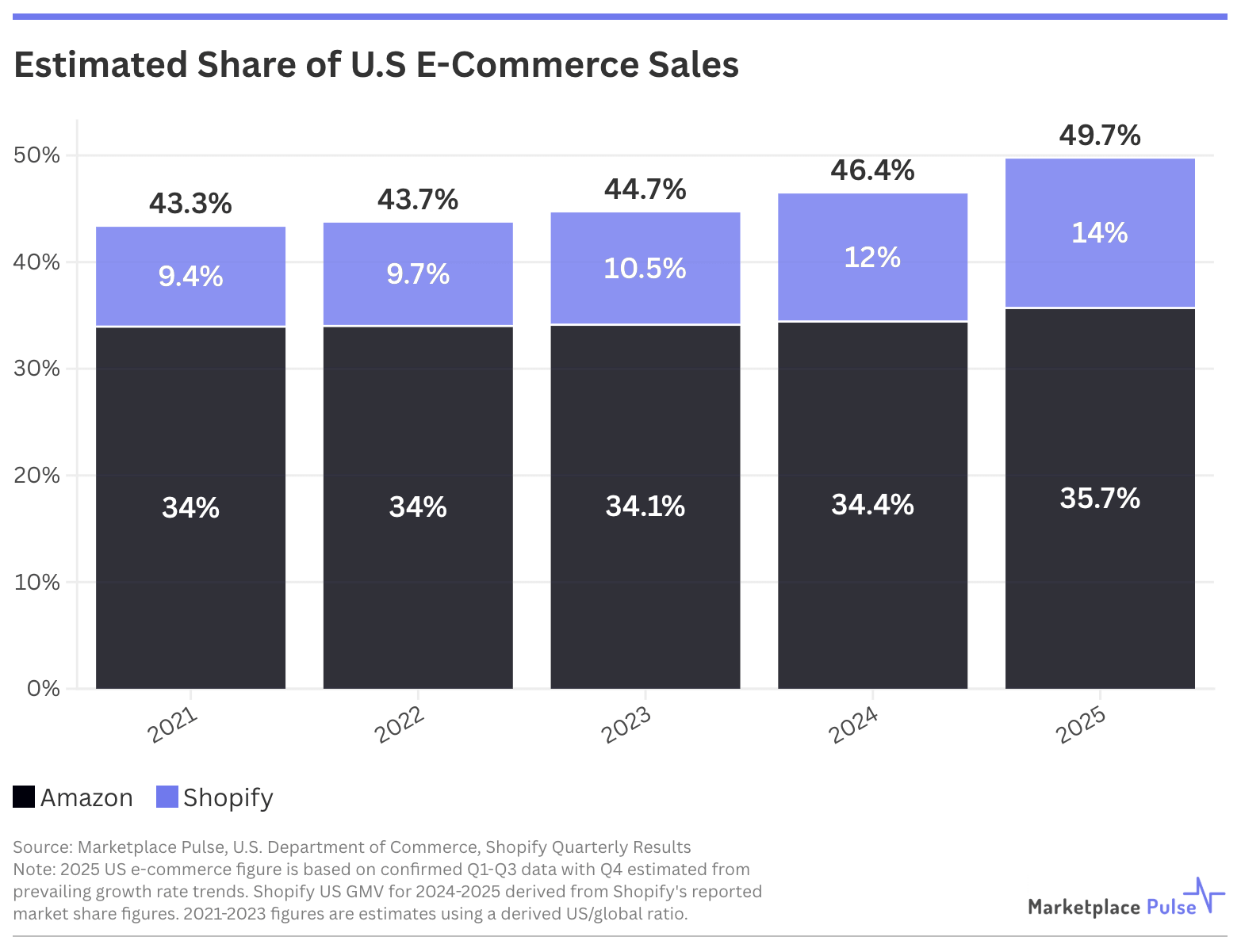
Amazon and Shopify now account for roughly half of U.S. ecommerce.
According to Marketplace Pulse, Amazon and Shopify together now power about 50% of all e-comm sales in the U.S.
Here is the breakdown that matters for operators.
• Amazon GMV: roughly $540B in 2024
• Shopify merchant GMV: roughly $235B
• Combined, that is close to half of total U.S. online retail
What is interesting is how different their roles are in the ecosystem.
Amazon dominates product search and demand capture.
Most shoppers start their purchase journey there.
Shopify dominates independent brand infrastructure.
It powers millions of brand-owned storefronts and direct customer relationships.
That split explains why most successful brands now run both channels.
💡 Operator takeaway: Amazon is a discovery and distribution engine. Shopify is a relationship and retention engine. You are not choosing one or the other. You are designing how they work together.
Brands that scale tend to design their channel strategy around this reality instead of trying to force one platform to do both jobs.
One tool, one brand, one agency to watch out for this week.
Brand Spotlight: Vital Proteins
Vital Proteins continues to show that collagen is more than a supplement. It’s a lifestyle habit.
The brand used Expo West this week to highlight new product innovation and reinforce its position as one of the most recognizable names in functional wellness.
What started as a niche collagen powder has grown into a category leader by doing something deceptively simple. They made collagen part of everyday routines like coffee, smoothies, and morning wellness rituals.
Instead of positioning collagen as a supplement you remember to take, Vital Proteins positioned it as something you naturally add to what you already consume. That shift unlocked repeat purchase and cultural relevance at the same time.
Operator takeaway: The strongest wellness brands do not just sell benefits. They build products that fit naturally into existing habits.
In the Toolkit: Flagship, Prediko, Rewize
Instagram post
Inventory is one of the fastest ways a growing brand can accidentally tie up cash.
Overstocks, stockouts, and missed forecasts compound quickly as SKUs, channels, and promotions scale.
A few tools operators are using to stay ahead of it:
Flagship – built for operational complexity with multi-warehouse visibility, bundle tracking, and subscription inventory alignment.
Prediko – demand planning based on real sales data, seasonality, and growth forecasts so operators can plan production with more confidence.
Rewize – focuses on inventory control and cash flow by helping rebalance stock before slow-moving SKUs turn into dead inventory.
Operator takeaway: inventory mistakes rarely come from bad products. They come from poor forecasting and limited visibility.
The brands scaling smoothly treat inventory like a data problem, not just a logistics one.
Agency Assist: Eleven
Eleven focuses on the lever that matters most in paid media right now: creative.
As CAC continues to rise across Meta and TikTok, the brands that win are not necessarily the ones spending the most. They are the ones iterating creative the fastest.
Eleven works with brands to build performance-driven creative systems instead of one-off ads. That means developing concepts, testing variations, and producing content that can evolve as platforms and algorithms change.
💡 For operators, this kind of approach helps solve one of the biggest bottlenecks in paid growth right now: the speed of creative testing.
Media buying is increasingly commoditized. Creative testing, iteration, and volume is where the real advantage lives.
Are you DTC (Down To Collab)?
At 1800DTC, we spotlight the real builders behind the tools and brands featured on our site and the DTC players putting those tools to work. Let’s collab:
For Brand and Tool Founders: