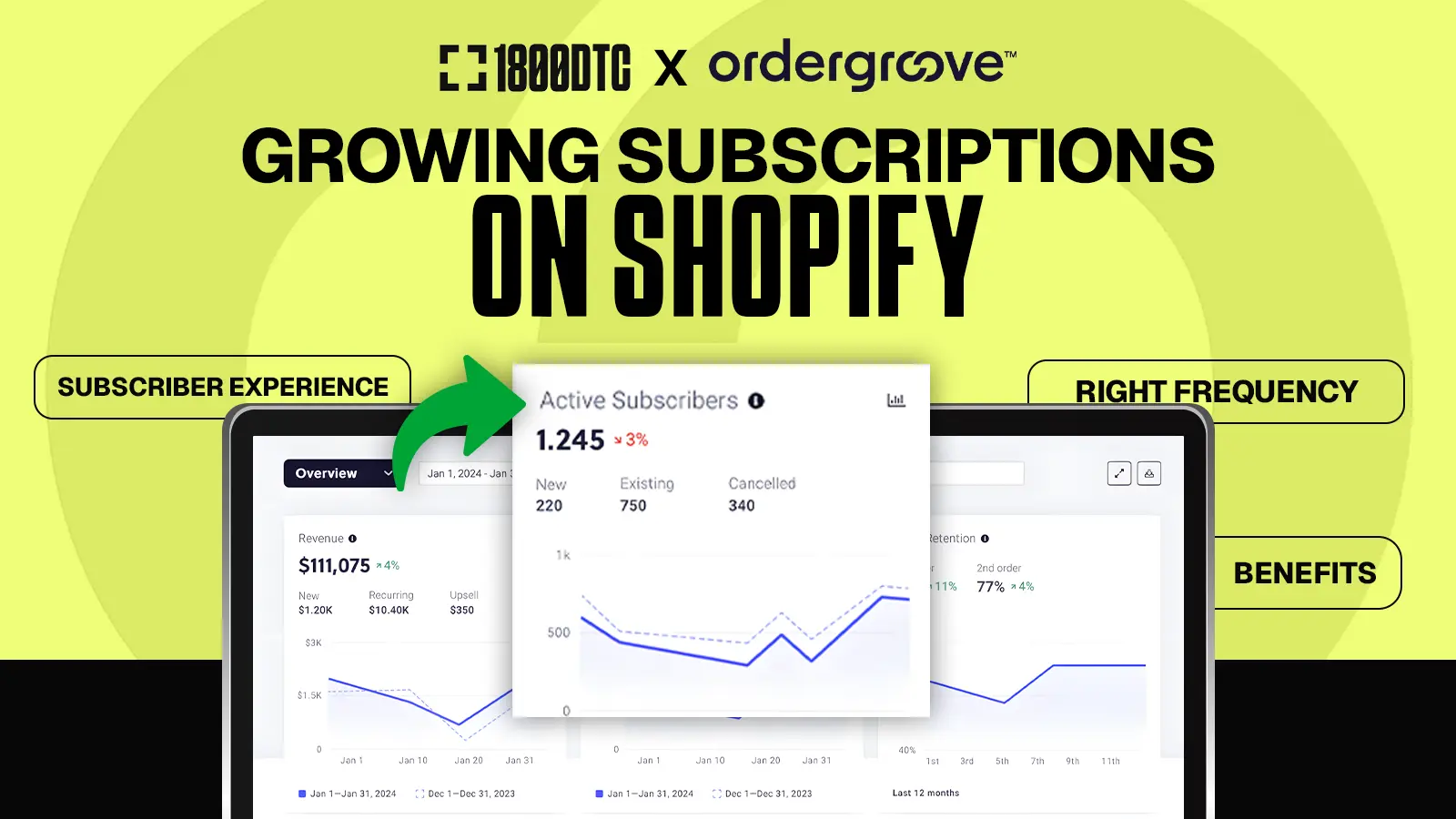
Whether you're a brand that already has subscriptions running or one that's about to flip the switch for the first time, the question remains the same: how do I actually grow my base? Not just launch a "subscribe and save" offer and hope for the best, but build a subscription program that compounds, retains, and compounds some more.
To grow subscriptions on Shopify, brands need to do five things well:
- Drive enrollment at high-intent moments
- Reduce avoidable churn
- Give subscribers more control
- Use incentives with precision
- Measure retention by cohort.
This guide breaks down the strategies that move the needle, the mistakes that quietly kill programs, and what the brands doing it right actually have in common.
Why Subscriptions on Shopify Are Worth Getting Serious About
The macro tailwinds are hard to ignore. The global subscription economy reached $492 billion in 2024 and is projected to nearly triple to $1.5 trillion by 2033. Subscription ecommerce revenue specifically grew 26% in 2024, and North America holds the dominant 38% share of that market.
For DTC brands on Shopify, the unit economics make the case simple. Subscription customers generate 3–5x more revenue over their lifetime compared to one-time buyers. Your best subscribers are also your best customers because they buy more, return more, and cost less to retain than to replace.
The catch? Most brands underinvest in the infrastructure and strategy required to actually drive subscription growth.. They launch the offer, but they don't build the experience around it.
Part 1: How to Grow Shopify Subscriptions If You Already Have a Program
If subscriptions are already live on your Shopify store, the growth levers are about optimization and retention, not just acquisition. The brands winning here are doing a few things differently.
1. Audit Your Enrollment Touchpoints
Most DTC brands put their subscribe-and-save offer in one place: the product detail page. That's table stakes, not a strategy. High-performing subscription programs surface enrollment offers across the entire purchase path: product pages, quick views, the cart, and checkout.
The logic is simple, a customer who's already decided to buy is the easiest person to convert to a subscriber. If you're not presenting the subscription offer at the moment of highest purchase intent (the cart and checkout) you're leaving enrollments on the table.
Ordergroove, a subscription platform used by brands like BARK, MANSCAPED, Liquid IV, Daily Harvest, e.l.f cosmetics, and Bonafide Health make the process of implementing and scaling a subscription model simple. By engineering the entire shopping experience, these brands set up subscriptions so the value of subscribing is obvious at every step, not an afterthought buried in the PDP.
2. Fix Your Churn Before You Scale Acquisition
This is the most common mistake in subscription growth. Brands try to grow the top of the funnel before they've fixed the hole in the bucket.
DTC subscription businesses experience an average churn rate of 6.5% across Consumer Goods and Retail. That might sound manageable, but compound it over 12 months and you're replacing the majority of your subscriber base just to stay flat. For consumables and replenishment categories, best-in-class programs run churn below 4%.
The good news is that a significant portion of churn is preventable:
Involuntary churn, caused by failed payments, accounts for a substantial chunk of subscriber losses. Smart retry logic and automated dunning management can recover a meaningful portion without any customer action required.
Voluntary churn is trickier, but flexibility is the clearest lever. Brands that give subscribers control to skip, pause, swap, or adjust frequency retain more people than those that don't. Offering the ability to pause, for example, has been shown to increase total payment value by nearly 5% in B2C contexts, because customers who would have canceled instead stay active.
Flexibility is one of the clearest retention levers in subscription commerce. OLLY is a great example. Their original subscription program only offered quarterly shipments with no flexibility, which contributed to high churn and limited LTV growth. After migrating to Ordergroove and rebuilding the subscriber experience around flexibility and control, OLLY grew their subscriber base by 73% in 12 months.
3. Use Incentives Strategically, Not Generously
Subscribe-and-save discounts are necessary to drive enrollment, but brands often miscalibrate them. A flat discount for every subscriber regardless of behavior or tenure erodes margin without building loyalty.
Smarter subscription programs use incentives more selectively, tying value to behavior in ways that encourage larger baskets, stronger retention or deeper engagements. bareMinerals, for example, integrates their loyalty program directly with subscriptions. By rewarding subscribers with deeper discounts and more loyalty points based on the number of active subscriptions they hold, they create a genuine "subscribe more, save more" loop that increases both AOV and retention simultaneously. You can see how they structure this in Ordergroove's best practices guide for subscriptions and loyalty.
Curated flex incentives, by contrast, are built to compound. Across a study of 100 top subscription brands, Ordergroove found that curated incentives drove 40% more repeat orders over the first nine subscription cycles compared to flat-rate discounts. By the ninth order, retention was more than twice as high.
e.l.f. Cosmetics took a similar approach with Ordergroove's Flex Incentives feature, which allows dynamic, behavior-based offers rather than static discounts.The result: 62% recurring revenue growth.
4. Build Your Cancel Flow
Most brands treat cancellation as a failure state. Smart brands treat it as a retention opportunity. A well-designed cancel flow is one that presents alternatives before a customer churns. Building something like this can recover a meaningful percentage of would-be cancellations.
The options matter: offer a skip, a pause, a product swap, a frequency adjustment. Surface them before the cancel confirmation. Exit surveys that ask why a customer is canceling give you data to fix the underlying issue at scale. No single retention tactic solves every cancellation. The strongest cancel flows adapt to the reason a subscriber is leaving, whether that is too much product, price sensitivity, timing, or product fit.
Ordergroove's Enhanced Cancel Flows are already saving 24% of churning subscribers for early adopters, not by strong-arming customers into staying, but by presenting the right alternative at the right moment. Gated discounts, flexible subscriber options, and 1-click self-serve actions give brands a configurable retention layer that goes up fast and works without heavy dev lift.
When paired with Ordergroove's Cancellation Analytics, the cancel flow becomes a diagnostic tool as much as a retention one. Understanding why subscribers leave is what sharpens every other part of your retention strategy.
5. Mine Your Cohort Data
If you're not looking at subscription retention by cohort, you're flying blind. Most programs see their biggest drop-off spike in the first 90 days. Research shows that 44% of cancellations happen within the first 90 days of a subscription. But the exact pattern is different for every brand and every product.
Mapping your cohort retention curves tells you exactly where to intervene. If your biggest drop happens between orders 1 and 2, you need better post-purchase nurture. If there's a cliff at month 3, consider whether your subscriber's supply has run out before they've seen real results and adjust your enrollment cadence accordingly.
Ordergroove's Performance Analytics dashboard is built for this: retention KPIs, churn rates by product, enrollment growth, and cohort-level visibility so teams can translate data into actual changes.
Part 2: How to Launch Shopify Subscriptions Without Creating Early Churn
For brands launching subscriptions for the first time, early growth usually comes down to getting a few fundamentals right: choosing the right products, setting the right cadence, making flexibility clear upfront, and building the retention infrastructure before churn starts.
1. Start With Your Replenishment Products
The easiest products to subscriptionize are the ones customers already reorder regularly. These are supplements, consumables, pet food, skincare staples, coffee. By having natural reorder cadences, subscriptions simply automate a behavior customers were already doing.
Replenishment subscriptions also tend to have the lowest churn rates: industry data puts them at below 4% monthly churn because the product delivers consistent, practical value.
2. Choose the Right Frequency
One of the fastest ways to create early churn is to set the wrong delivery cadence. If a customer subscribes monthly for a product they use every six weeks, they accumulate supply and eventually cancel. The fix is to offer flexible frequency options from the start, or use onboarding questions to help customers choose the right cadence.
Guided selling experiences, such as short quizzes, can help customers choose the right product and frequency before the first order ships. Ordergroove's optimization guide points to Yankee Candle as a clean example: a short quiz that discovers fragrance preferences and routes shoppers to the right product before they even add to cart.
3. Design the Enrollment Offer Carefully
The first enrollment offer sets the tone for the entire relationship. The most effective offers combine a meaningful incentive with a clear articulation of subscriber control, giving shoppers a reason to sign up and reassurance they’ll still have flexibility after checkout Research shows that 34% of subscribers sign up specifically because of a "cancel anytime" guarantee, not just the discount. Flexibility is a selling point, not a risk.
Offering a free gift alongside enrollment has been shown to boost sign-ups by 27%. A strong first-order incentive is worth the margin cost if subscriber retention holds.
4. Integrate Your Email and SMS Stack from Day One
The post-enrollment experience determines whether first-time subscribers become long-term ones. Brands that integrate their subscription platform with tools like Klaviyo or Attentive can automate the entire subscriber journey. Everything from upcoming order notifications, skip/pause prompts, milestone rewards, and re-engagement flows for at-risk subscribers.
Personalized retention emails have been shown to reduce cancellations by 12%. One-click subscriber actions via email or SMS, where customers can skip an order without logging in, dramatically reduce friction and the likelihood of cancellation driven by annoyance rather than genuine dissatisfaction. Ordergroove's Shopify integration connects natively with Klaviyo and Attentive for this exact reason.
5. Set Up Dunning Management Before You Launch
Failed payments are one of the most predictable sources of early subscription loss, which is why dunning and payment recovery should be set up before launch, not after. Involuntary churn from failed payments will happen from day one. Having retry logic, automated payment failure notifications, and proactive card refresh prompts set up before launch means you're not scrambling to recover revenue you didn't know you were losing.
As Swanky Agency's DTC subscription team notes, passive churn from failed payments is one of the easiest problems to solve, but only if you've set the systems up in advance. This is a non-negotiable infrastructure, not a nice-to-have.
The Platform Decision: What to Look for in a Shopify Subscription App
Shopify's native subscriptions API provides the rails, but not the strategy, analytics, or retention tooling required to actually grow a program. Most DTC brands need a dedicated subscription management platform layered on top.
When evaluating options, here’s the criteria that matters most:
Subscriber experience and control. Can subscribers easily skip, pause, swap, or adjust frequency without contacting support? Self-service is table stakes. The less friction in account management, the lower your churn.
Enrollment flexibility. Can you surface subscription offers at every touchpoint (PDP, cart, checkout) without custom dev work? Can you run A/B tests on enrollment offers?
Retention tooling. Does the platform have built-in dunning management, cancel flows, and churn prediction? Reactive retention is expensive. Proactive retention is infrastructure.
Analytics depth. Can you see retention by cohort, churn by product, enrollment growth over time? If you can't measure it, you can't improve it.
Integration ecosystem. Does it connect natively with Klaviyo, your loyalty platform, Gorgias, Attentive? Subscriptions don't exist in isolation, they need to talk to your full stack.
Ordergroove is used by many of the Shopify brands scaling subscriptions most effectively.. By supporting the full subscriber lifecycle — from acquisition and enrollment to subscriber management, retention, and performance analytics — Ordergroove gives brands clearer visibility into what’s working and where to optimize.
A few of the brands on Ordergroove’s Shopify integration that stand out:
For brands new to subscriptions, Ordergroove has a specific launch path designed to get programs live without heavy development resources. For brands migrating off another platform, Ordergroove maintains a 99.9% migration success rate with processes built to keep existing subscribers intact through the transition.
Honorable Mentions Beyond Shopify
While Shopify is the dominant platform for DTC subscription programs, it's worth noting that Ordergroove also supports brands on other major platforms.
BigCommerce
Merchants on BigCommerce can access the same Ordergroove subscription infrastructure. Enrollment experiences, subscriber management, retention tooling, and analytics are all natively integrated with the BigCommerce checkout. It's a fit for brands that have built on BigCommerce and want enterprise-grade subscription capabilities without replatforming.
Salesforce Commerce Cloud
Ordergroove's Salesforce integration also supports full subscription lifecycle management within SFCC environments, giving enterprise teams the subscriber experience and retention tooling their scale requires. For brands running complex catalog structures or multi-channel operations on Salesforce, it's the cleaner path to subscription growth than building something custom.
The Bottom Line
Growing subscriptions on Shopify isn't a launch problem, it's an operations problem. The brands with the healthiest subscription programs have done the less glamorous work: fixing churn before scaling acquisition, building flexible subscriber experiences, using cohort data to find and fix drop-off points, and choosing infrastructure that compounds over time rather than creating technical debt.
The market is growing. The opportunity is real. And the brands that treat subscriptions as a core revenue model are the ones that will own the recurring revenue advantage for years to come.











.png)






.png)