Travis Halff is the founder and owner of Y'all, a boutique performance creative and digital marketing agency that helps DTC brands scale their paid acquisition channels. Y’all is a nod to Travis’ Texas roots and a reminder that great marketing starts with understanding and connecting with your audience, your “Y’all.”
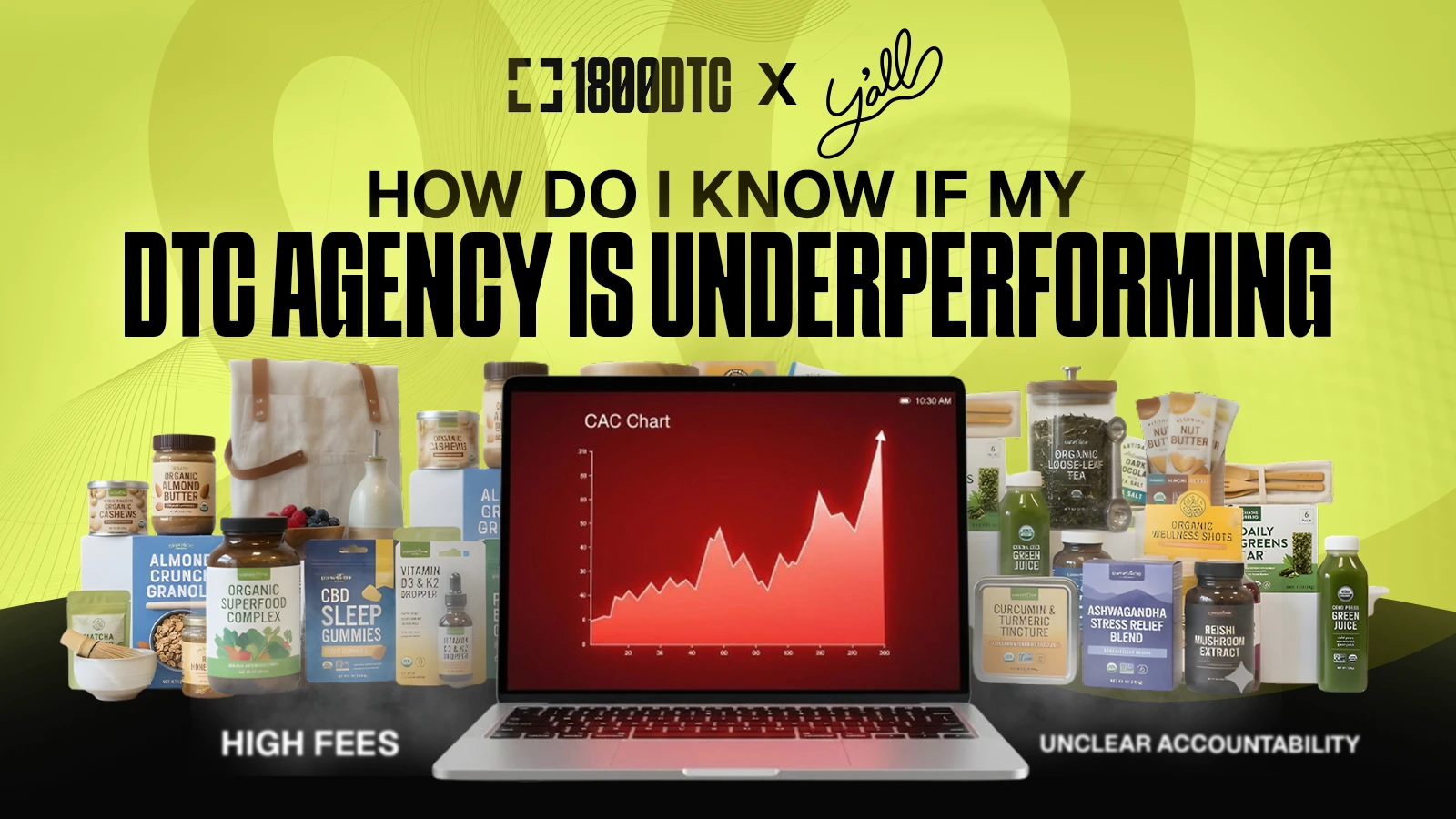
How Do I Know If My DTC Agency Is Underperforming?
A bad agency gets fired quickly. The mistakes are obvious and the decision to get rid of them is easy. The expensive problem is the mediocre agency. The agency that produces just enough activity to avoid scrutiny while your growth stalls and your unit economics quietly deteriorate…
I've run a DTC growth agency for years now, and the relationship between a founder and their growth agency is one of the most consequential decisions in the business. When it's working, the agency becomes an extension of your team, driving profitable growth, testing strategically, and owning outcomes. When it's not, you're left with reports that may look impressive, but a business that isn't scaling profitably.
The problem is that underperformance often hides behind activity. Agencies produce deliverables, run campaigns, and present data. But activity and progress are two different things. Many founders stay with underperforming agencies longer than they should because the signs of dysfunction are subtle or deliberately obscured.
This article helps you identify the specific indicators that your agency relationship might not be working, the questions to ask to surface the truth, and what to do if you come to the decision that it's time for a change.
The Core Question: Are They Accountable to Outcomes or Optics?
The simplest diagnostic for agency performance is this: Does your agency treat your business like their business, or like a client relationship to be managed?
Agencies that own outcomes act differently than agencies that manage perceptions. They prioritize decisions that drive long-term profitability over short-term metrics that look good in reports. They tell you straight up when something isn't working before you have to ask. They restructure their own compensation when it's misaligned with your goals.
Agencies that manage optics tend to do the opposite. They optimize for the appearance of progress. More campaigns launched, more creatives delivered, more meetings held, all without focusing on whether any of it is moving the business forward.
The gap between these two approaches is the difference between a strategic partner and a vendor delivering a service.
Red Flag #1: Creative Has Flatlined
The clearest signal of agency underperformance is creative stagnation. Not a dip in performance over a single week, but a sustained plateau where no new creative approach is breaking through and the agency has no compelling hypothesis about why.
Meta's own research consistently shows ad creative drives the majority of campaign effectiveness, yet it's the area where agencies most often fail to deliver sustained innovation.
What stagnation looks like:
The same winners recycled endlessly. Your agency keeps launching variations of the one concept that worked six months ago, with diminishing returns over each iteration.
No new angles breaking through. Every test batch performs roughly the same and the agency can't articulate why or what they're changing in the next round.
Volume without variance. The agency produces dozens of ads per month, but they all look visually similar and use the same handful of angles. Post-Andromeda, Meta's algorithm penalizes redundancy. Launching 15 ads that the platform reads as identical is worse than launching 3 truly distinct concepts. Creating unique visual and angle variants takes significantly more work, but it's the only path forward in the current algorithmic environment.
No creative opinion. When you ask what's working in the category or what new approaches they want to test, the answers are generic or rely entirely on what your competitors are doing.
When we began working with ZYN Turmeric, the brand had plateaued with their previous agency after exhausting their initial creative approach. By developing a creative testing framework that prioritized differentiated concepts over volume, performance improved dramatically, but only because the focus shifted from hitting deliverable counts to finding breakthrough creative.
The deeper problem:
Creative stagnation usually comes down to a failure of strategic investment, not execution. Producing truly differentiated creative requires deep product knowledge, audience research, willingness to test bold ideas that might fail (and that don't come from templates), and tight collaboration with founders. It's expensive and risky for many agencies.
Agencies working on fixed retainers with thin margins have every incentive to minimize this investment. It’s easier to produce more of what's safe, hit the deliverable count in the contract, and move on to the next client.
Red Flag #2: Attribution Theater
The second major indicator of underperformance is attribution theater. Reporting that looks sophisticated but obscures rather than clarifies what's actually driving growth.
What attribution theater looks like:
Every channel claims credit for the same purchase. Facebook reports a 3X ROAS. Google reports 4X. Your agency's dashboard shows a "blended" number that's even higher. But your actual bank account and P&L don't reflect any of it.
ROAS is up, but profit is flat or declining. The agency celebrates improving efficiency metrics, while your contribution margin erodes because the media mix has shifted toward low-intent traffic or customer acquisition costs have risen faster than average order value.
No incrementality discussion. Your agency can't or won't answer the question: "What would happen if we turned this channel off?" They deflect to correlation-based attribution instead of designing tests to measure true lift.
Post-purchase survey data is ignored. When you ask how customers say they found you, the agency dismisses the data as unreliable rather than reconciling it with their attribution model.
The problem with attribution theater is that it makes bad decisions look good. An agency can optimize toward a metric that satisfies their reporting without actually growing your business. And because most founders lack the internal analytics capacity to challenge the narrative, the dysfunction persists.
The question to ask:
"If we cut this channel's budget in half for four weeks, what would happen to total revenue and profit?"
If your agency can't give you a confident answer backed by either incrementality test data or a clear logical model, they may be reporting attribution, not managing a business.
Red Flag #3: The Fee Structure Was Never Designed for Alignment
Most agency agreements get structured at the start of the relationship and never revisited. The fee model gets set based on industry convention or whatever the agency's standard proposal template says, not based on what would actually create the right incentives for how the engagement will work in practice.
Every pricing model creates specific behavioral dynamics. None of them are inherently broken. But all of them can become misaligned if the structure doesn't match the engagement. The red flag is an agency that has never examined whether the model is serving your business, or one that gets defensive when you bring it up.
What to watch for on a retainer model
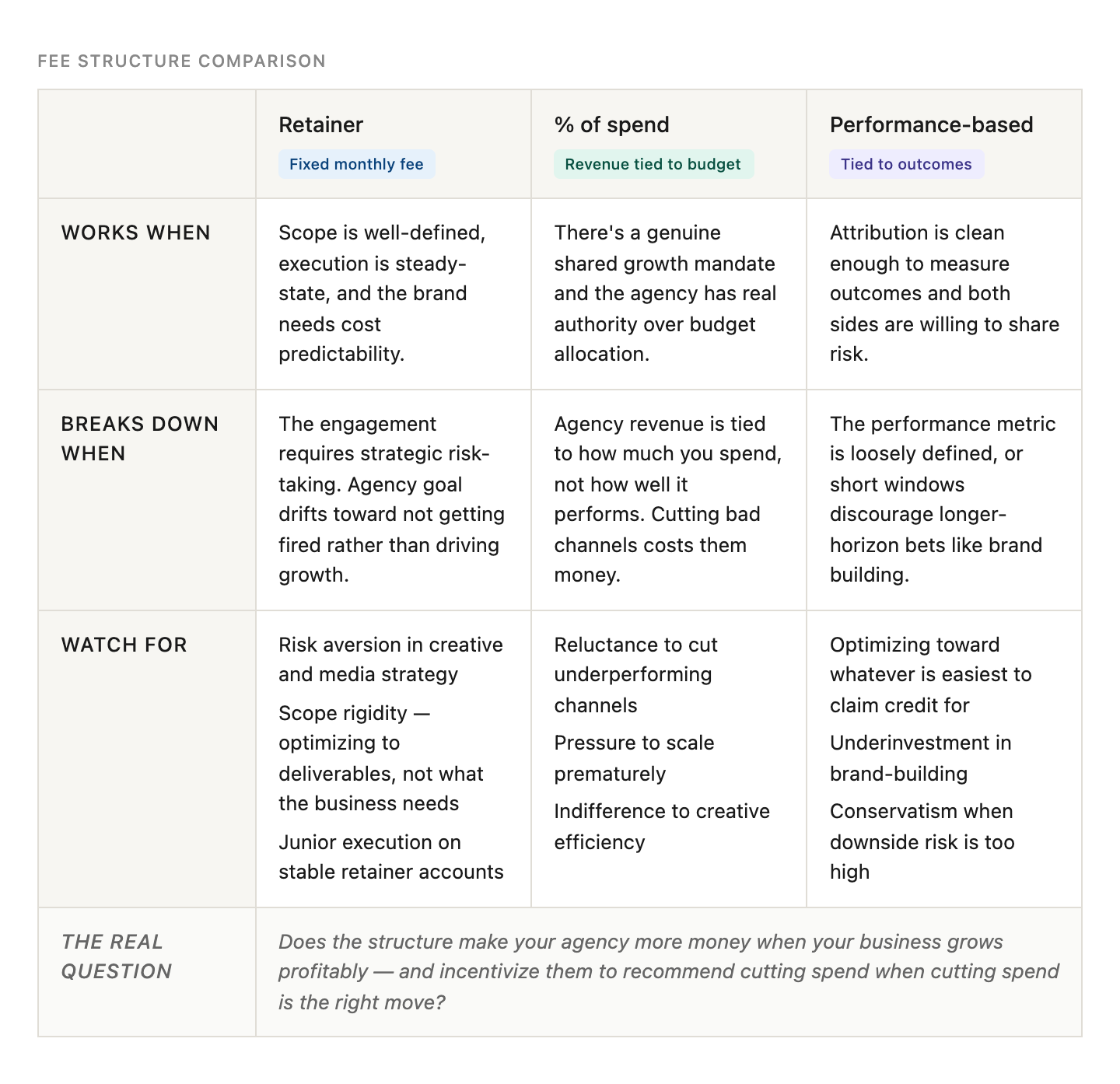
Retainers make sense for execution-heavy, steady-state work where the scope is well-defined and the brand needs cost predictability. The structure breaks down when the engagement requires the agency to take strategic risk on your behalf. Because a retainer pays the same regardless of outcomes, the agency's primary business objective can drift toward simply not getting fired. You'll see risk aversion in creative and media strategy, where testing bold approaches becomes a threat to the relationship. You'll see scope rigidity, where the agency optimizes to the deliverables in the contract rather than what the business actually needs. And you'll see effort arbitrage, where senior talent gets allocated to new pitches and at-risk accounts while stable retainer clients get junior execution.
None of that means retainers are bad. It means that if you're on a retainer and your agency is responsible for driving growth (not just executing a defined playbook), you should be asking whether the structure is creating the right pressure.
What to watch for on a percentage-of-spend model
Percentage-of-spend can work when there's a genuine shared growth mandate and the agency has real authority over budget allocation. The structure breaks down when the agency's revenue is tied to how much you spend rather than how well that spend performs. Watch for reluctance to cut underperforming channels (if 20% of your budget is going to a channel that's probably not incremental, the agency has a financial reason to defend it), pressure to scale prematurely because their revenue depends on budget expansion, and indifference to creative efficiency since there's no upside for the agency in making existing spend work harder.
What to watch for on a performance-based model
Performance-based structures tie agency compensation to business outcomes like revenue growth or profit contribution. When attribution is clean enough to measure and both sides are willing to share risk, this can create strong alignment. But performance models have failure modes too. If the performance metric isn't carefully defined, the agency optimizes toward whatever is easiest to claim credit for. When compensation resets monthly or quarterly, there's an underinvestment in longer-horizon bets like brand building or new audience development that won't pay off within the measurement window. And if the agency bears too much downside risk, they become conservative in exactly the moments when you need them to push.
Fee Structure comparison for dtc agencies
The diagnostic that actually matters
Does your agency's compensation structure make them more money when your business grows profitably? Does the structure incentivize the agency to recommend cutting spend when cutting spend is the right move? Is there a mechanism for the structure to evolve as the engagement matures? Would the agency voluntarily propose restructuring their own compensation if the current model wasn't producing the right behaviors?
If the answer to those questions is no, you're managing an incentive conflict. And if your agency gets defensive when you raise these questions rather than treating them as a healthy part of the relationship, that tells you something important.
Red Flag #4: No Single Accountable Owner
The most common structural problem in underperforming agency relationships is diffusion of accountability. You're paying for a team, but no single person owns the outcome.
What this looks like:
Your "main contact" is a client services person, not the strategist running the account. They're skilled at managing the relationship but don't make the actual decisions about creative direction, budget allocation, or testing strategy.
Different people own different channels. Paid social is one person, Google is another, creative is a third. No one is looking at the whole business and making tradeoffs across channels. No one can answer why you're spending $50K/month on Google when the last incrementality test showed it wasn't driving lift.
You don't have regular access to the person actually doing the work. Strategy gets filtered through layers of account management. By the time you hear the recommendation, the context and nuance are lost.
This is a failure of structure, not individuals. Agencies organized into functional silos (media buying, creative, analytics) with client services as the interface will never deliver the same quality of decision-making as a single experienced operator who owns the entire growth function for your business.
When Pamos switched to us, one of the most significant structural changes was moving from a fragmented agency team with multiple points of contact to a single senior growth lead who owned the full P&L responsibility for their paid acquisition. Decision-making speed increased, accountability was clear, and strategic coherence replaced channel-siloed optimization.
The question to ask: "Who is the single person accountable if we miss our growth targets this quarter, and do I have direct access to them?"
Red Flag #5: They Don't Tell You When Things Aren't Working
The most important thing your agency should be doing is telling you the truth when performance is declining, before you have to surface it yourself.
This sounds obvious, but it can be rare to find. Most agencies are conditioned to manage the client relationship, which means framing everything as a learning opportunity, emphasizing the long-term strategy, and deflecting accountability when results are poor.
What good looks like:
Your agency proactively flags when a channel or campaign is underperforming relative to the target with a specific hypothesis about why and a proposed solution.
They tell you when a test failed and what they learned, without spin.
They challenge your own assumptions when you're wrong, even if it's uncomfortable.
They say "I don't know" when they don't have an answer, rather than producing plausible-sounding explanations that aren't grounded in evidence.
The honesty across the board, whether on performance, strategy, or through conversation, is a good relationship at play. On the other end, there's clear signs of what may be a bad relationship.
What bad looks like:
Every weekly call is a performance recap with no forward-looking accountability.
When you raise a concern, the response is defensive rather than investigative.
The agency waits for you to notice problems rather than surfacing them first.
There's always a reason why this week's performance is an outlier, never a pattern that requires strategic change.
The agency's job is to tell you the truth about what's working, what's failing, and what needs to change. If you're not getting that, you're getting client services rather than a strategic partnership.
Red Flag #6: They're Running Too Many Ads (That All Look the Same)
One of the most deceptive forms of agency underperformance is volume theater. Producing dozens of ad variants to hit contracted deliverable counts while creating no actual diversity in what's being tested.
What this looks like:
The weekly report shows 20+ new ads launched, but when you look at them, they're all the same hook with minor visual variations or the same scene with slightly different opening frames.
Post-Andromeda performance is flat or declining. Meta's algorithm now penalizes redundancy. When the platform reads multiple ads as essentially identical, it doesn't give them proper distribution. You're not running 20 tests. You're actually running one muddled test twenty times.
No clear testing framework. The agency can't explain what variable is being isolated in each new ad or what they expect to learn. They're producing volume because the contract says "45 ads per month," not because there are 45 distinct strategic hypotheses to test.
Creating unique visual and angle variants requires significantly more work than reskinning the same concept. It means developing new product narratives, shooting different scenes, testing contrarian hooks that might fail. This is the only path forward in the current Meta environment, but agencies stuck in the old way of operating have every incentive to avoid this harder, riskier work.
When FlavCity came to us, one of the first things we changed was replacing low-variance creative production with a testing framework that prioritized genuine differentiation. The total volume of creative actually went up over time, but we stopped counting "new ad with a different colored background" as a distinct concept. Every ad in a test batch had to represent a unique hypothesis: a different angle, a different format, a different audience entry point. Performance improved because Meta's algorithm could actually distribute the creative to distinct audience segments instead of clustering it all together.
The question to ask:
"Can you show me the last batch of creative you launched and explain what unique variable each ad was testing?"
If the answer is vague or the ads all look functionally identical, your agency is optimizing for optics, not performance.
What To Do If You See These Red Flags
If multiple indicators in this article describe your current agency relationship, you have three options:
1. Attempt to restructure the relationship
If the underperformance is a function of misaligned incentives or unclear accountability rather than fundamental capability, it may be fixable:
Renegotiate the fee structure. Move toward performance-based compensation tied to profit or revenue growth, not spend or deliverables.
Consolidate accountability. Require a single senior owner who is responsible for all growth functions and has direct access to you.
Define a new operating cadence. Establish clear expectations for how performance is reported, how decisions are made, and how tests are designed and evaluated.
This works when the agency has the capability but not the structure. It falls apart when they lack the strategic depth or are unwilling to accept outcome-based accountability.
2. Supplement your agency with in-house resources
For brands spending $2M+ on ads, hiring an internal quarterback to help manage agencies from the inside is a viable option:
Hire a senior growth lead. Someone who has owned P&L for a DTC brand and can operate across creative, media, and analytics, with the ability to push back on agencies when needed.
Invest in infrastructure. Attribution tooling, creative production capabilities, and analytics resources that allow you and your agencies to make decisions with better data.
The risk of going all in-house is that building it out is expensive, slow, and trickier when things don’t work out. For most brands spending less than $2M per month, this is prohibitively costly.
3. Switch to an agency structured around outcomes
The fastest path to fixing underperformance is finding an agency whose business model and structure solve the problems that caused your current relationship to fail:
Performance-based pricing that aligns their revenue with your profit growth.
Single accountable owner, a senior strategist who runs the full growth function for your business and has direct access to founders.
Creative-led approach that prioritizes testing new concepts, not recycling old winners or hitting volume quotas.
Transparency on attribution and willingness to design incrementality tests rather than defend platform-reported ROAS.
I built Y'all around exactly these principles because I kept seeing the same patterns play out. Brands that were plateaued or declining with traditional agency models saw step-function improvements in performance within months of switching to an outcome-aligned structure. Not because the tactics changed dramatically, but because the incentives did.
Final Take: The Cost of Staying Too Long
The biggest mistake founders make with their agency is staying in one six months too long.
The cost goes well beyond the retainer you're paying. It's the compound effect of deteriorating unit economics as CAC rises and creative fatigues without intervention. It's the missed growth windows when your product-market fit is strong, but acquisition isn't scaling because the agency can't execute. It's the opportunity cost of capital deployed into underperforming channels instead of the highest-return tests. And it's the strategic drift as the gap between where your business is and where it should be widens each month.
If you're reading this article because you're questioning your current relationship, trust the instinct. The signs may be uncomfortable to act on, but they are rarely wrong.
The best agencies want clients who hold them accountable. If your current partner isn't interested in that, it might be time to talk.
Frequently Asked Questions
How do I know if my DTC agency is underperforming?
Look for sustained creative stagnation without a clear hypothesis for why, attribution reporting that doesn't reconcile with your actual P&L, a fee structure that was never designed around aligned incentives, no single person accountable for your growth targets, and an agency that waits for you to notice problems rather than surfacing them first. Any one of these warrants a conversation. Multiple signals together suggest a structural issue.
What should I look for in a performance marketing agency for DTC brands?
The most important factors are how the agency structures accountability (a single senior owner beats a fragmented team), how their compensation aligns with your outcomes, how they approach creative testing (genuine diversity versus volume for its own sake), and whether they're willing to have honest conversations about what isn't working. The specific tactics matter less than the structural incentives.
How can DTC brands improve their ad campaign ROI?
Start with creative diversity. Meta's Andromeda system rewards genuinely different concepts across visual styles, messaging angles, and formats. Beyond creative, make sure your attribution model isn't giving you false confidence in underperforming channels, and audit whether your agency's fee structure creates incentives that align with profitable growth rather than just spend volume.
What is the best fee structure for a DTC marketing agency?
There's no single correct answer. Retainers work well for clearly scoped, execution-heavy engagements. Percentage-of-spend models work when there's a shared growth mandate. Performance-based models work when attribution is clean enough to measure outcomes. The right question is whether the structure incentivizes your agency to make decisions that grow your business profitably, and whether there's a mechanism to revisit the model as the engagement evolves.
How often should I evaluate my marketing agency's performance?
Run a structured evaluation at least quarterly. But the informal evaluation should be ongoing. Are you learning something new from every creative test batch? Is your agency surfacing problems before you notice them? Are they challenging your assumptions rather than just executing what you ask for? The best agency relationships involve continuous, honest dialogue about what's working and what needs to change.
How do I scale DTC ad spend without losing efficiency?
Scaling profitably requires creative that the algorithm can distribute to new audiences without cannibalizing existing performance. That means investing in genuinely differentiated concepts across formats (static, video, creator content) rather than producing more of what already works. The brands that scale efficiently are the ones investing in creative infrastructure, not just media spend. It also means your measurement infrastructure needs to evolve with your spend, so you can distinguish channels that are driving incremental growth from those that are just taking credit for it.
When should a DTC brand switch agencies?
When the structural problems are unfixable. If your agency resists conversations about fee alignment, can't provide a single accountable owner, produces volume without creative diversity, or consistently lets you discover performance problems before they surface them, these are structural issues that a reset meeting won't solve. The cost of staying too long almost always exceeds the cost of transition.















.png)