
Does Your Growing CPG Brand Need an ERP? The $55 Million Bet on the Operations Cloud as a Solution

If your CPG brand is at the point where operations are outpacing your systems, the answer isn't always a traditional ERP. Sometimes it's a smarter operational layer that adapts to your strategy instead of constraining it.
That's the thesis behind a $55 million Series B just raised by DOSS to aid in building for the next decades-long shift in enterprise software. It's one of the larger raises in the operations software space this year, and it's aimed squarely at the problem every scaling CPG and DTC brand eventually runs into: your tools can't keep up with your business.
But before you look at what DOSS is building, it's worth asking the harder question first.
Do You Actually Need an ERP?
There's a moment every growing brand hits. Orders are flowing in from your Shopify store, Amazon, a retail partner or two, and maybe wholesale. Your 3PL is flagging inventory discrepancies. Your ops team is reconciling spreadsheets until midnight. And someone on the leadership team says: "We need an ERP."
Maybe. But probably not in the way you think.
A traditional ERP makes sense when your financial infrastructure needs consolidation: multiple legal entities, international subsidiaries, auditor requirements, tightly controlled AP/AR workflows. That's what systems like NetSuite and SAP were built for, and they do it well.
But most CPG brands don't reach for an ERP because of finance. They reach for one because operations are falling apart. Inventory is a mess, purchase orders take forever, nobody can answer "what's our real margin on this SKU?", and every new retail partner creates a week of manual work. The instinct (or perhaps the mandate from your investor team...) often is to buy a system that does a bit of everything well: stores data, houses your GL, and manages your supply chain — a true all-in-one ERP solution.
The problem? ERP implementations consistently fail to meet their objectives. Average cost overruns stretch well past what was budgeted, timelines blow out from months to years, and by the time the system goes live, your business has already changed. You've added two retail partners, switched co-manufacturers, and launched a product line that doesn't fit the data model you just spent six months configuring. Now you're filing change requests and waiting weeks for adjustments that should take hours.
The Actual Problem: Your Ops Layer, Not Your Ledger
Here's what's worth diagnosing before you sign a six-figure software contract. If you look at what's actually breaking, it's usually not the general ledger. QuickBooks, Xero, or whatever accounting system you're running is probably doing its job fine.
The pain lives in everything else: the messy web of inventory management, procurement, order routing, freight, and fulfillment that keeps goods, dollars, and data flowing through your business.
Cramming these into a traditional ERP often creates more problems than it solves, because ERPs model operations through the lens of financial transactions, not how your supply chain actually works.
Why $55 Million Is Flowing Into a Different Approach
This is what makes the DOSS raise significant for DTC and CPG operators.
The company isn't building another ERP. It's building what it calls an Operations Cloud: a system that sits alongside your existing accounting tools and manages the flow of physical goods, money, and data without forcing you to rip anything out.
In practice, that means modules for inventory, procurement, order management, freight, fulfillment, warehouse management, and demand planning, all built on a single unified data layer that adapts as your business changes. You keep QuickBooks or NetSuite for accounting. DOSS handles the operational complexity around it.
[inline-cta title="Hop on a call with the Director of Partnerships at DOSS, Evan, to learn more" link="https://calendar.app.google/St7Qp42F3RUampdb6"]
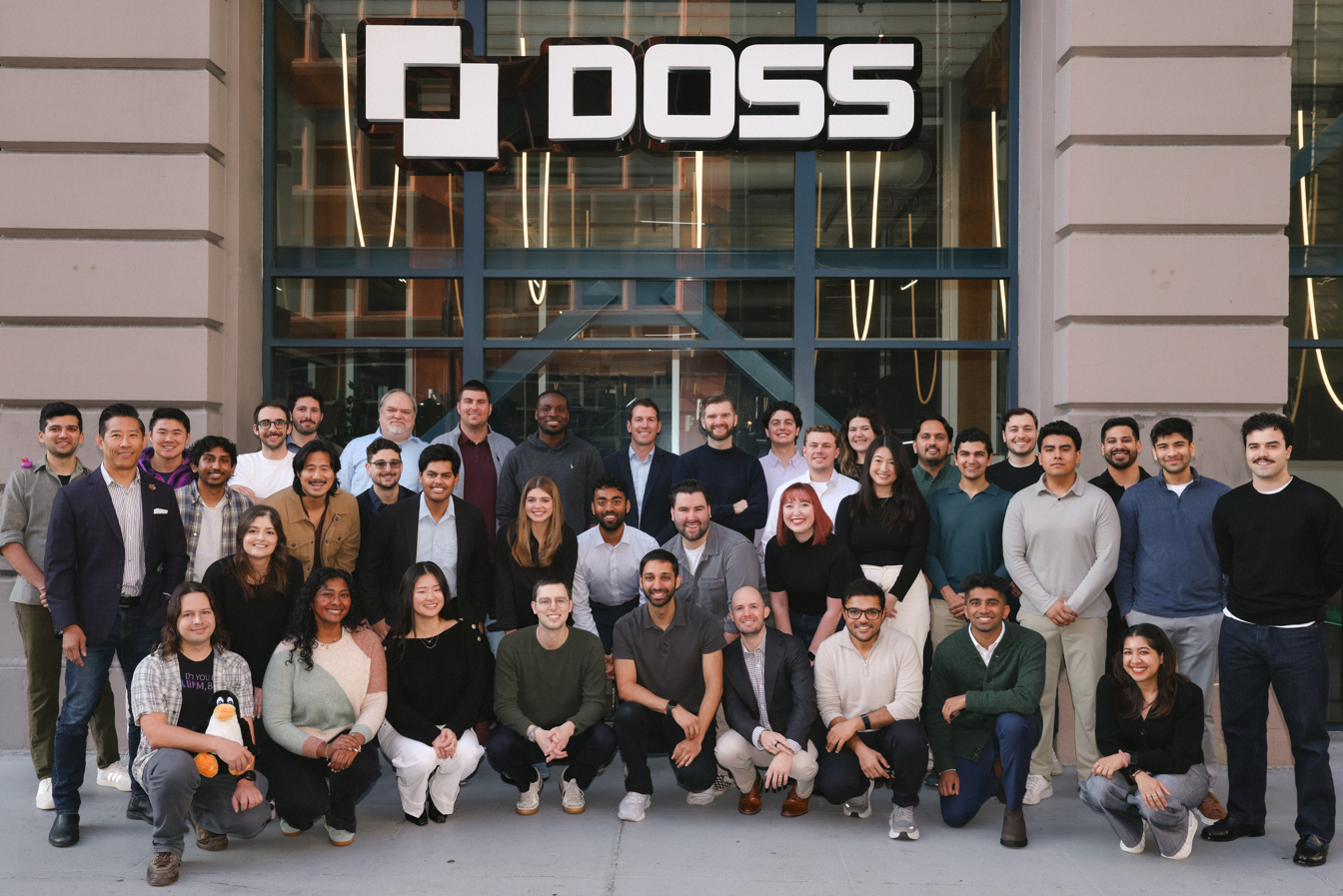
This approach is what led to a a $55M Series B raise, co-led by Madrona and Premji Invest, with Greyhound, Commerce Ventures, and Intuit Ventures as new investors, and continued investment from Theory, General Catalyst, Contrary Capital, Mintaka, and Pathlight VC, and 47th Street Partners.
Karan Mehandru, Managing Director at Madrona, is joining the DOSS board. He is an investor in Zapier, Outreach, Cohesity, Auth0, Fyxer, GrowthX, Algolia, Klaviyo, Deepgram, Clerk, Charta, Trek Health, and others.
Premji Invest's team had a few key insights on the coverage of their investment. The first being that every ERP is a rigid data model and nobody has thought to rearchitect it. Every "innovation" was just replatforming. "For every $1 in ERP software, companies spend $5 to $9 on implementation services." The second being that complexity became the moat for sellers because of this. DOSS starts where the problem is: the data, then actually rearchitects. The investment followed because they were DOSS as solving one of the last software problems in the space.
What This Looks Like in Practice
The strongest signal from this raise isn't the investor names. It's the customer results.
Verve Coffee Roasters, a specialty coffee brand managing sourcing, roasting, retail, wholesale, and DTC, uses DOSS to unify production, inventory, orders, and dollars. They cut manually batched orders from 30% down to 1% and saved over 20 hours per week across their warehouse team. They kept their existing accounting system intact the entire time.
Mezcla, a plant-based protein bar brand experiencing rapid year-over-year growth across DTC, wholesale, and retail, was drowning in manual data entry. Every order required hand-keying across systems, and a single decimal error could materially hit revenue. After implementing DOSS, they automated order-to-cash workflows, doubled PO processing speed, and saved 12+ hours weekly.
There’s a noticeable pattern for CPG brands scaling operations: the business didn't slow down to fit the software. The software adapted to the business.
When You Don't Need an ERP (And What to Do Instead)
If your core pain is operational, not financial, you likely don't need a traditionall ERP. You need to fix the operational layer directly: lock down your master data, unify your inventory view, automate procurement and order management, and do it in a way that feeds clean data back into whatever GL you're already running.
You probably don't need a traditional ERP if:
- Your accounting system works and your CFO isn't complaining about the general ledger.
- Your real challenge is inventory visibility across multiple locations and partners.
- You're buried in manual PO creation, order triage, and spreadsheet reconciliation.
- You can't afford to wait six to twelve months for value.
In these scenarios, the smarter move is a platform composable enough to adapt as your operations evolve, rather than locking you into a configuration you'll outgrow in a year. Start with the most painful area, whether that's procurement or inventory, and layer on capabilities as the business grows.
This is the "middle path" that a growing number of CPG brands are taking: somewhere between suffering with spreadsheets and betting the company on a monolithic ERP.
What This Means for Your Tech Stack
DOSS's $55M raise reflects a broader shift that DTC and CPG operators should be paying attention to. The era of one-size-fits-all enterprise systems is giving way to composable, AI-native tools that plug into your existing stack instead of replacing it.
For example, the company's AI copilot, Dossbot, lets operators make changes, fix data errors at scale, and run reports through simple chat prompts. Instead of submitting a ticket and waiting for a consultant, your ops lead can ask the system to update vendor terms across hundreds of records or generate a landed cost report in seconds.
For brands in the $5M to $250M revenue range that sell physical products across multiple channels, the takeaway is straightforward: you have more options than you think. You don't have to choose between spreadsheet chaos and a massive ERP commitment. The operational layer is becoming its own category, one purpose-built for the speed and complexity of modern CPG.
If the biggest investors in enterprise software are putting $55 million behind that thesis, it's worth paying attention to what it means for your stack.
Frequently Asked Questions
When does a CPG brand actually need an ERP?
A traditional ERP makes sense when your core challenge is financial, not operational. However, if your accounting software works fine and your real pain is inventory visibility, manual purchase orders, or spreadsheet reconciliation across channels, a full ERP may be more system than you need.
What is the difference between an ERP and an Operations Cloud?
An ERP is a monolithic system designed to centralize finance, HR, inventory, and other departments into a single database. An Operations Cloud is a modular platform that focuses specifically on the flow of physical goods, money, and data across your supply chain. The key difference is that an Operations Cloud sits alongside your existing accounting tools.
Why do ERP implementations fail for growing brands?
ERP implementations frequently miss their objectives because of the mismatch between how fast a business changes and how rigid the system is once configured. A typical deployment takes six to twelve months of customization. By go-live, many growing CPG brands have added new retail partners, switched suppliers, or launched product lines that don't map to the data model.
What should a DTC brand look for in an ERP alternative?
The most important factor is adaptability. A DTC brand should look for a platform that can deploy in weeks rather than months, start with the module where you feel the most pain (usually inventory or procurement), and expand over time without requiring a full re-implementation.
How do CPG brands manage inventory across multiple sales channels without an ERP?
The most common approach for brands in the $5M to $100M range is a patchwork of point solutions: Shopify for orders, QuickBooks for accounting, Airtable or Google Sheets for inventory tracking, and a 3PL portal for fulfillment. The emerging alternative is an operational platform that unifies these.
What is DOSS and how does it fit into a DTC tech stack?
DOSS is an AI-native Operations Cloud designed for inventory-based businesses. It provides modules for inventory management, procurement, order management, freight, fulfillment, warehouse management, and demand planning, all on a single, unified adaptive platform. Brands like Verve Coffee Roasters and Eight Sleep use DOSS to manage operational complexity across multiple channels while keeping their current financial systems intact.

DOSS Operations Cloud is a unified suite of applications that manage the flow of goods, dollars, and data across your business. Track landed costs, unify inventory and orders across locations, optimize demand-based purchasing, and automate your entire value chain with one powerful source of truth


