The DTC Affiliate Playbook: Fix Your Attribution, Stop the Fraud, and Keep Your Best Affiliates Posting

Based in Austin, Yash is the founder and CEO of SARAL, an influencer marketing platform used by hundreds of DTC health, wellness, beauty, and lifestyle brands, and SATHI, a Shopify-native affiliate platform showing brands what's working and what isn't.
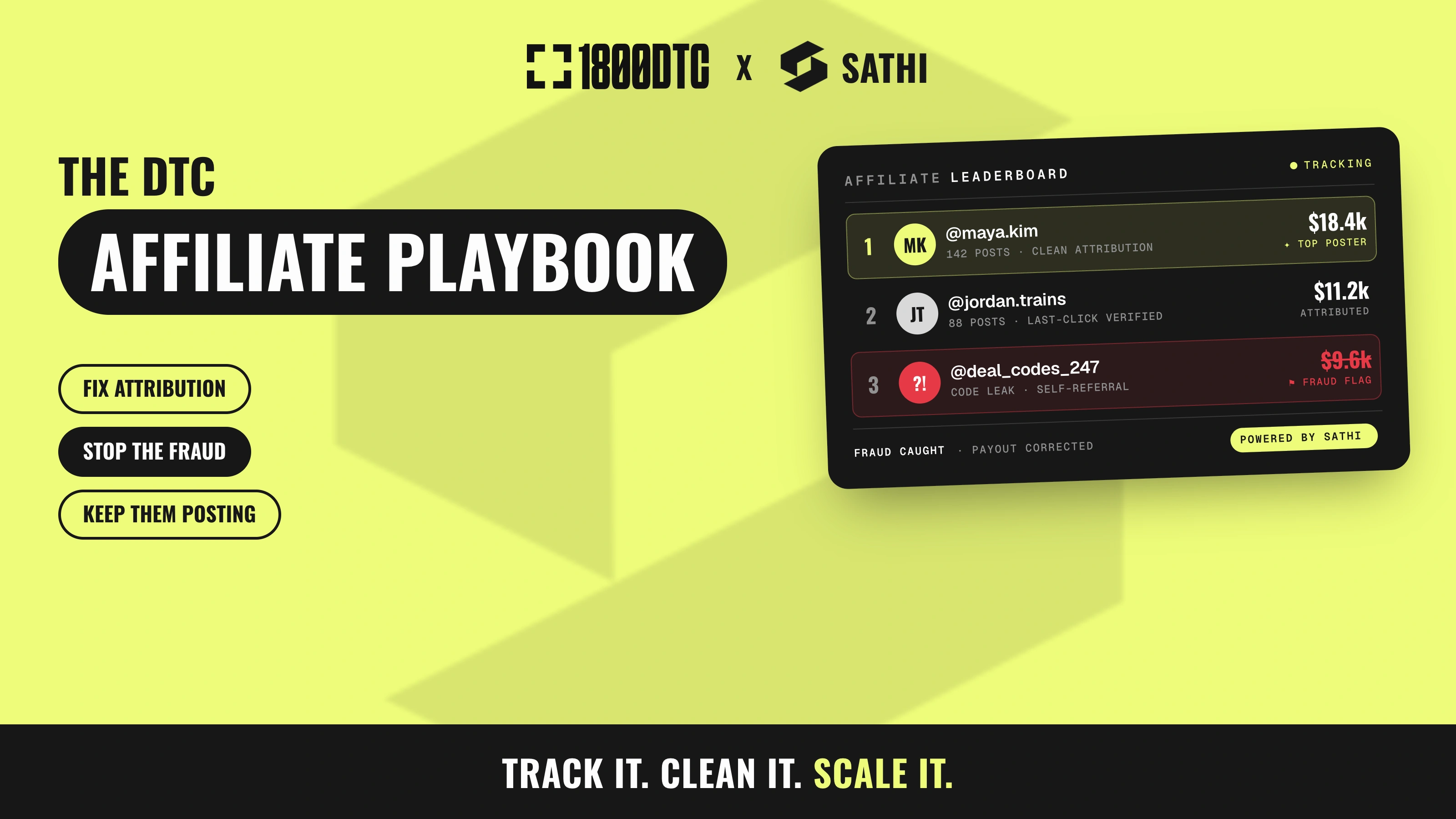
Why’s everyone talking about affiliate right now? On Meta, you pay for impressions. On Google, you pay for clicks. On affiliate, you pay for sales.
That's the pitch. It's the main reason why CFOs love it in a way they've never loved influencer spend or brand campaigns. If you set a 20% commission, that's a 5x ROAS. You set 10%, that's 10x.
You can reverse-engineer the return you want before you sign a single affiliate deal.
The other reason affiliate is having a moment is because Instagram opened external links on Reels. Before this, the only direct-response format on Instagram was Stories. Stories disappear in 24 hours, reach maybe 10% of a follower base, and cap at a short video. Reels can go viral, reach well beyond an existing audience, and now link directly to your Shopify store. The highest-reach format on Instagram is now a direct-response tool.
TikTok Shop has spent two years proving that when people are financially incentivised to post, they post more and they make better content. Meta noticed and decided it was time to do the same.
The platforms are building toward affiliate-native commerce, and the brands that set up their programs now will be ahead when that infrastructure fully lands.
Last-Click Attribution Is Rewarding the Wrong People
Almost nobody talks about this openly, because it requires admitting that the data you're looking at could be wrong. Affiliate programs have a measurement problem. It shows up in two directions, and both are costing you money.
#1: You're underpaying the people who earned it
Five affiliates post about your brand over a weekend. Someone watches three of those videos, searches your brand name on Monday, clicks a Google ad, and buys. Your dashboard says the Google ad drove the sale. The five affiliates get nothing.
Or, five affiliates post, a customer clicks through four of their links across two weeks, then buys using the last person's discount code. That last affiliate gets 100% of the commission. The other four get zero.
This is last-click attribution, and it's how every major affiliate platform currently operates.
It made sense when affiliates were bloggers and email lists, and the path from discovery to purchase was short and linear. It stops making sense when a customer might see your product across TikTok, Instagram, and YouTube over ten days before they ever open their wallet.
The creators doing the education and awareness work stop getting commissions. They stop posting. Your program loses its best performers from the top, and you're left with whoever happened to be last in the funnel.
This is how you’re overpaying the people who intercepted the sale.
#2: Your affiliate partners cash in on the end of the journey
On the other side, some affiliates are skilled at positioning themselves at the end of the purchase journey without doing any of the work that got the customer there.
Code leaks are the most common version of this (more on that in the next section), but the pattern is the same. Last-click systems reward whoever got the final touchpoint, regardless of how that touchpoint came about.
The result of both together: you're underpaying the creators driving awareness and consideration, and overpaying the ones who are intercepting customers at checkout. The program bleeds from both ends.
The question worth asking about any affiliate commission is:
Would this sale have happened without the affiliate's involvement?
If yes, that spend isn't moving your business forward. If not, it is.
Getting clear on that distinction (what's incremental vs what's not) changes how you read your affiliate dashboard entirely.
Affiliate Fraud Is More Common Than Your Dashboard Shows
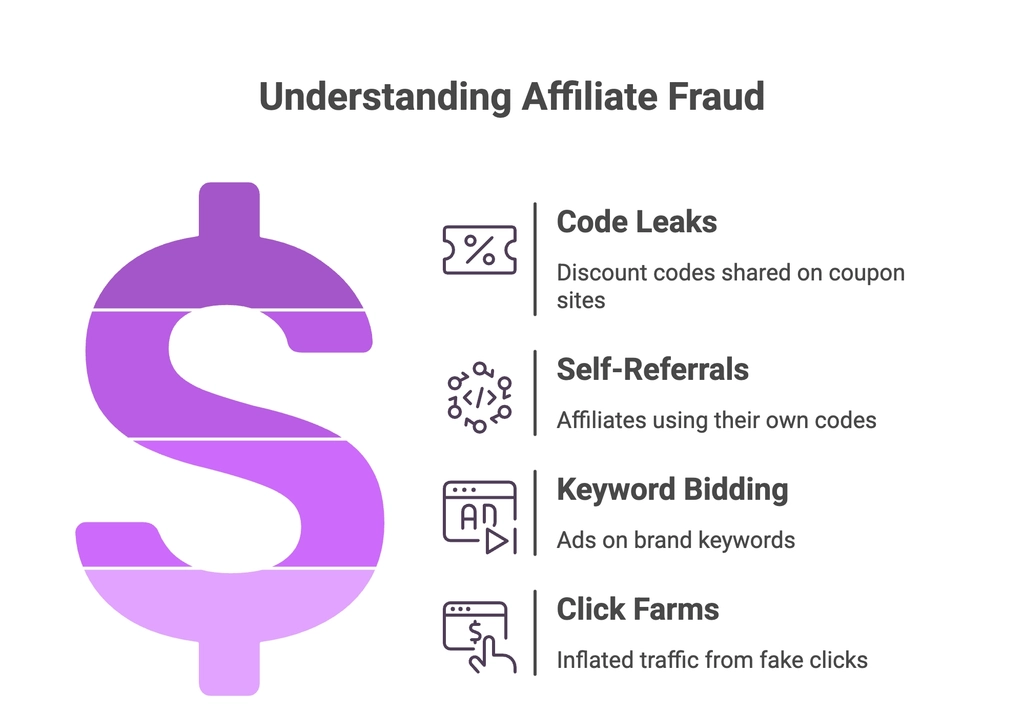
Affiliate fraud, courtesy of SATHI
When one brand recently onboarded to SATHI, their data showed a single affiliate had driven $40,000 in sales over a quarter! Every other affiliate was averaging $500-$1,000. When they looked up the affiliate's profile, it was a mom creator with 3,000 Instagram followers.
That mismatch is a signal. A code scan confirmed it: the affiliate's discount code had been sitting on Reddit, Honey, and Capital One Shopping for months. The brand had already paid out roughly $9,000 in commissions for sales that would have happened regardless.
This isn't rare. Across affiliate programs of any meaningful size, 5-20% of commissions tend to be fraudulent.
The types vary:
- Code leaks are the most common. A creator's discount code ends up on a coupon aggregator site. Browser extensions inject it at checkout. Every person who uses it gets attributed to that creator, whether they ever saw their content or not.
- Self-referrals are exactly what they sound like: an affiliate orders your product using their own code, collects the commission, and sometimes refunds the order afterward. Basic fraud engines catch this when the email addresses match. More advanced ones flag it when IPs, billing addresses, or order patterns are similar enough to suggest the same person.
- Keyword bidding is a more aggressive version. An affiliate runs paid ads against your brand keywords, drives traffic through their affiliate link, and collects commission on sales your own Google campaigns would have captured. You're paying twice. Once for a competitor clicking on your terms, and once in affiliate commission for the conversion.
- Click farms show up when affiliates are paid on a cost-per-click basis. Traffic gets inflated from locations where you don't even ship. The commission accrues. No one buys.
The reason fraud goes undetected in most programs is that standard dashboards only surface the headline number: this person drove X in sales. Without anomaly detection or code leak scanning, the pattern stays invisible until you go looking for it, or until the commissions are already paid out.
How To Build an Affiliate Program That Holds Up at Scale
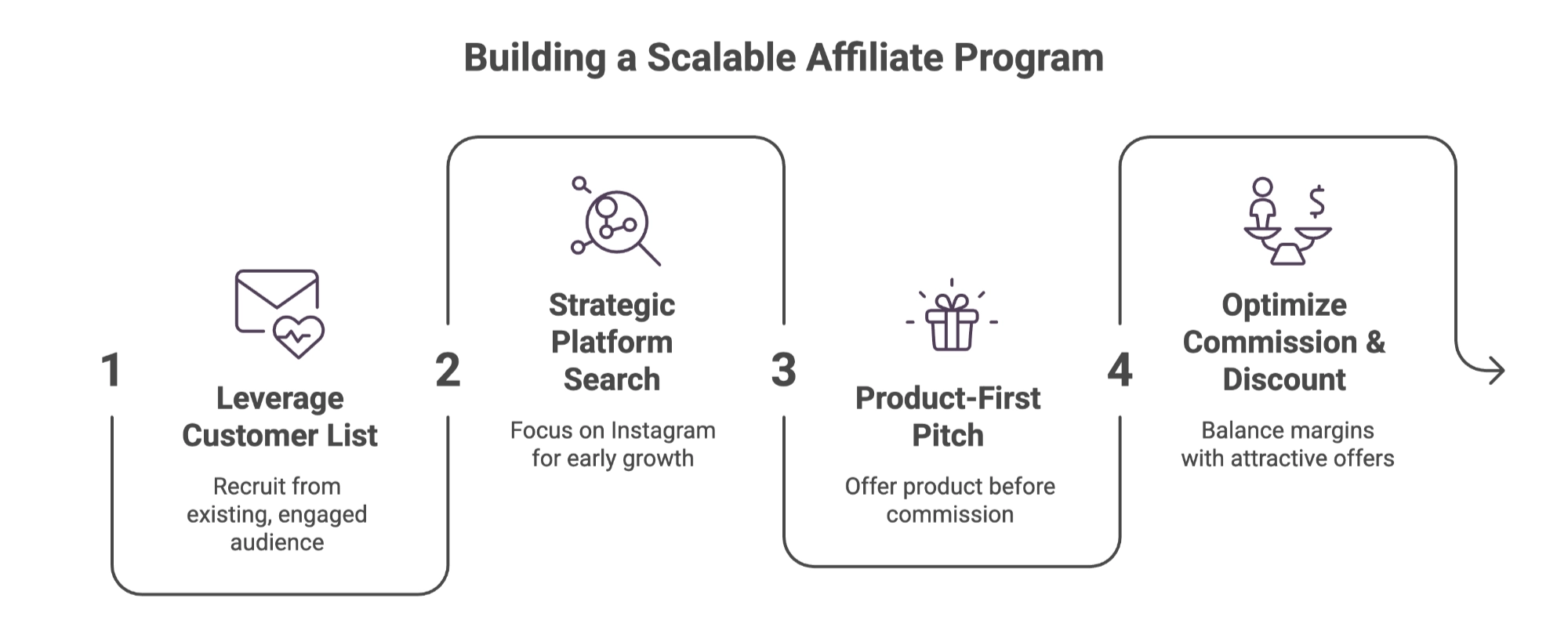
What building a scalable affiliate program looks like, courtesy of SATHI
1. Start with your customer list
The best place to find affiliates is your own email list, well before Instagram or any marketplace
- If you're a brand doing $1M+, you have tens of thousands of customers. A meaningful percentage of them are creators. An email to your list asking who wants to promote your product, with a simple threshold like "3,000+ followers on any platform", is the fastest way to seed a program with people who already know and like what you sell. Inbound is the most underleveraged channel for affiliate recruitment, and most brands skip it entirely.
- After that, search on the platforms your customers use. For most DTC brands starting out, Instagram is the right call. TikTok biases toward virality but not toward clicks off-platform. YouTube typically requires enough production effort that creators expect upfront payment. Instagram sits in the middle: reasonable reach, linkable in Reels and Stories, good for building an early affiliate base.
- For following size: under 20,000-30,000 is the sweet spot. Above that, creators expect flat fees and won't join a commission-only structure unless you're a brand they're already enthusiastic about.
The criteria that matters most is whether your ideal customer would watch this person's content, well ahead of follower count. A supplement for men over 50 has a different creator profile than a pre-workout for 22-year-olds. Even if both post under the hashtag "fitness," they're reaching completely different people.
How to pitch
Lead with the product, and let the affiliate program come second.
A DM offering 15% commission is easy to ignore. A DM saying "love your content, we'd like to send you our product with no strings attached, and if you like it we'd love to talk about working together" is much harder to pass on.
Get them the product first. See who posts without being asked. Those are your best affiliate candidates, because they've demonstrated enthusiasm before there was any financial reason to.
Commission and discount structure
Two decisions matter here, and they're connected.
On commission: look at your gross margins and work backwards. If you have 60% margins and can afford 40% for customer acquisition, splitting that between affiliate commission and customer discount is a reasonable starting point. The exact split depends on your category and AOV, but the principle holds: give as much commission as you can without losing money on the first sale.
On discount: whatever your affiliates offer customers has to beat what's already on your website. If you have a 20% welcome pop-up and your affiliates are offering 10% off, customers will take the pop-up. The affiliate's code becomes redundant. Match your best existing offer at minimum, or beat it. The discount needs to feel exclusive, or there's no reason for anyone to use it over what they'd find by themselves.
When you're just starting: one commission level, one discount, for all affiliates. Add tiers once you have enough volume to know what performance thresholds make sense.
Why Affiliates Stop Posting, and What To Do About It
The most common reason affiliate programs stall isn't a recruitment problem. It's a retention problem. Most programs onboard affiliates, hand them a commission rate, and leave them there.
For a few months, that can work. But a flat commission with no progression and nothing new to work toward stops feeling worth the effort. Creators can have multiple brand deals competing for their attention. If yours isn't actively rewarding their performance, it slides down the list.
The fix is a program structure that gives people something to move toward.
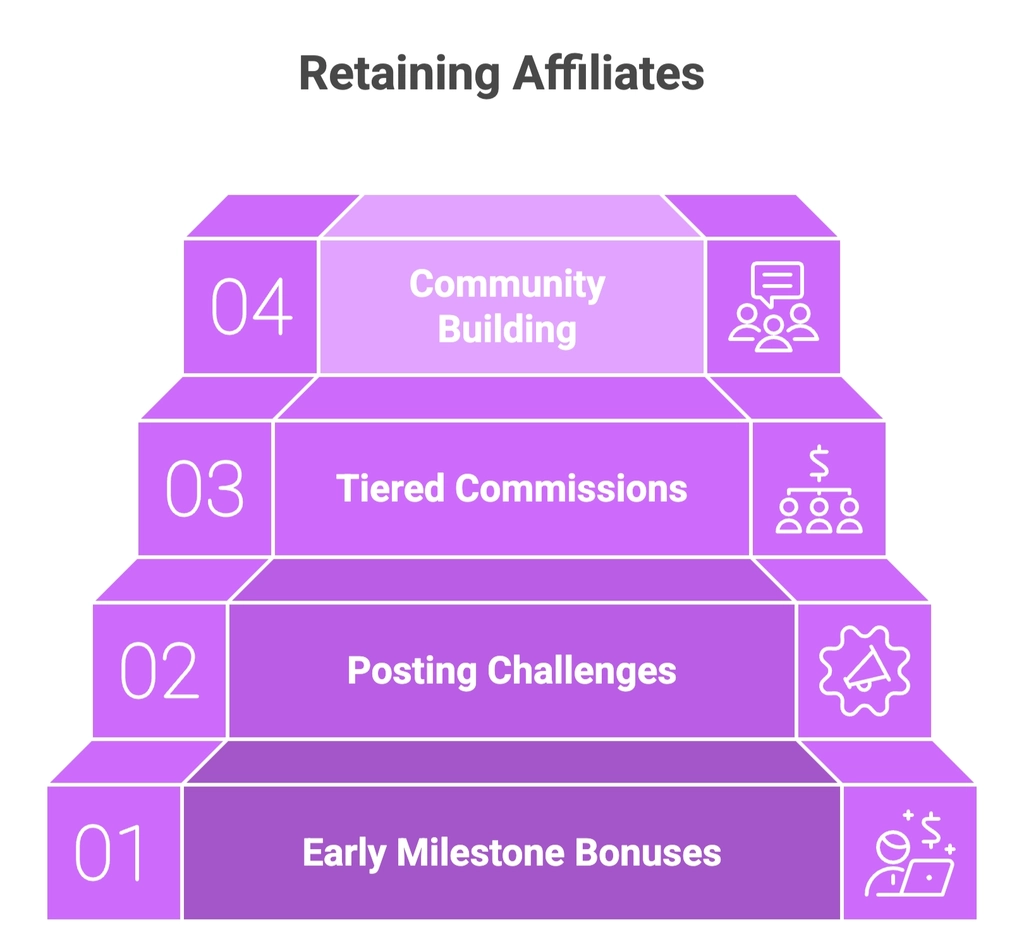
Steps to retaining affiliates, courtesy of SATHI
1. Start with early milestone bonuses.
Make the first one achievable fast. When a creator drives their first $100 in sales, send them a free product. When they hit $5,000, send a cash bonus. The first milestone needs to feel within reach. If the first jump requires 100 sales and most of your affiliates are doing 8, nobody bothers trying. The goal is to get a creator to hit a milestone early, so they feel the loop working, and then build from there.
2. Posting challenges work on the same logic.
"Post three times in the next two weeks and get a $200 bonus" is a short-term goal with a clear reward. It's the same incentive structure a sales team uses. People work toward defined targets better than open-ended ones. If you're running this on a platform like SATHI, you set the rule once and the platform tracks the behavior and fires the reward automatically.
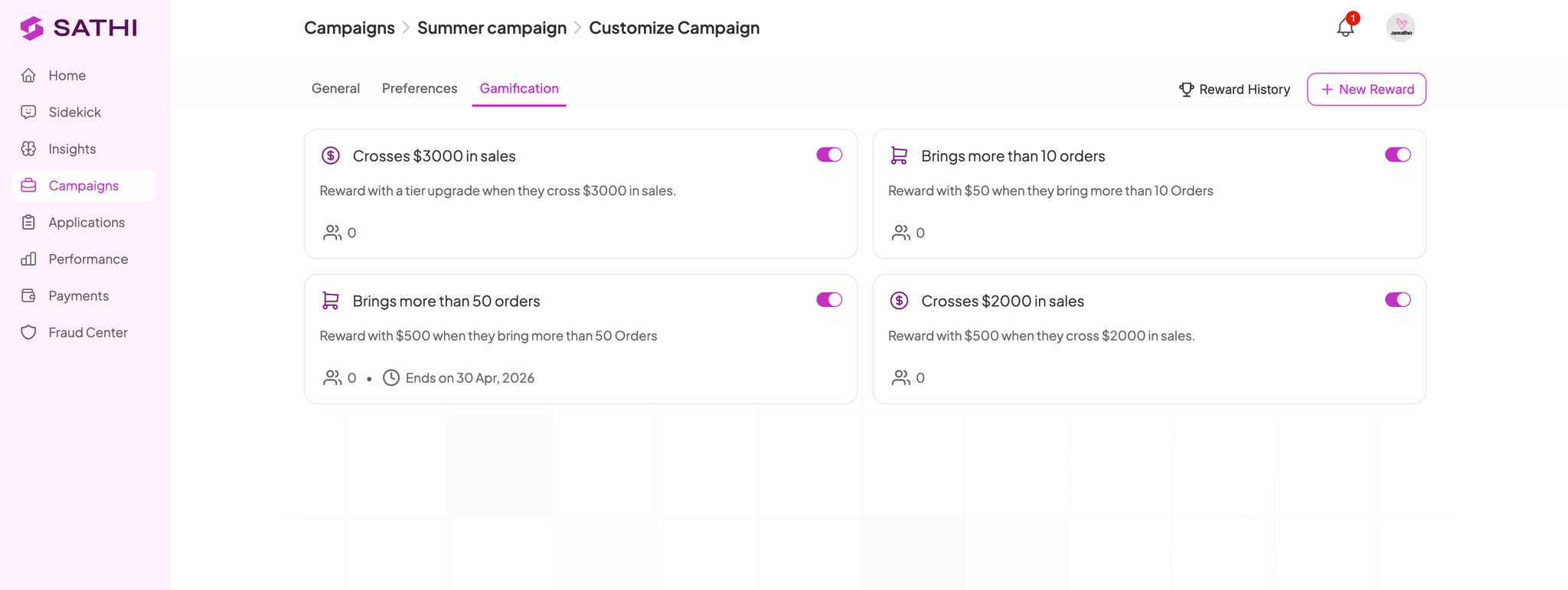
SATHI campaign dashboard
3. Tiered commissions give creators a longer runway.
Starting at 15%, moving to 20% at a certain sales threshold, then 25% beyond that, with each tier feeling achievable from the one below it. The goal isn't a big number at the top. It's that every creator can look at the tier above them and think they could get there with a bit more effort.
4. Beyond the financial structure: build a community.
A private group (Slack, WhatsApp, Discord) where affiliates can see each other's wins, ask questions, and feel like they’re part of something beyond just a commission deal, is underrated as a retention tool. The Commission keeps people posting. Feeling like they are a part of something keeps them from leaving.
Make sure to keep your top-of-funnel running regardless. Some churn is natural and expected. Always onboarding new affiliates means a drop-off from one creator doesn't stall the whole program.
Your Affiliate Content Is Your Best Ad Creative
Performance creative is one of the hardest things to scale on paid social. The best hooks, the most credible testimonials, the content that makes someone stop mid-scroll: it rarely comes from a studio shoot. It comes from a creator who uses the product and talks about it the way their audience talks.
If your affiliate program is running well, you're sitting on exactly that.
When a creator posts about your product and drives traffic through their affiliate link, that audience is warm. They've seen the endorsement, they've clicked through with some level of intent. The ones who don't convert on the first visit are a retargeting pool. The most effective creative to serve them is the creator's own content.
For brands running both paid and affiliate, this is where the two channels stop operating in separate silos and start feeding each other.
- Affiliate content builds your creative library
- Affiliate traffic seeds your retargeting audiences
- Paid media closes what affiliate warmed up
The full picture looks less like two channels and more like a system operating as one.
A Note on the Platform Behind This Guide
SATHI is a Shopify affiliate platform featuring cookieless multi-touch attribution, an automated fraud engine scanning for code leaks, and a self-managing gamification layer keeping affiliates motivated.
This guide and SATHI were built on insights from SARAL, an influencer platform used by top brands like Grüns, Spacegoods, and Slumberkins.
Observing hundreds of affiliate programs, problems kept repeating: last-click attribution rewarding wrong people, unnoticed code leaks draining margins, and flat programs losing affiliates.
Book a demo here or get 20% off + done-for-you migration from your existing affiliate platform with code 1800 at signup.
Join 17k+ subscribed
Get The eCommerce Pulse
The twice-weekly briefing for operators, founders, and partners shaping modern DTC.