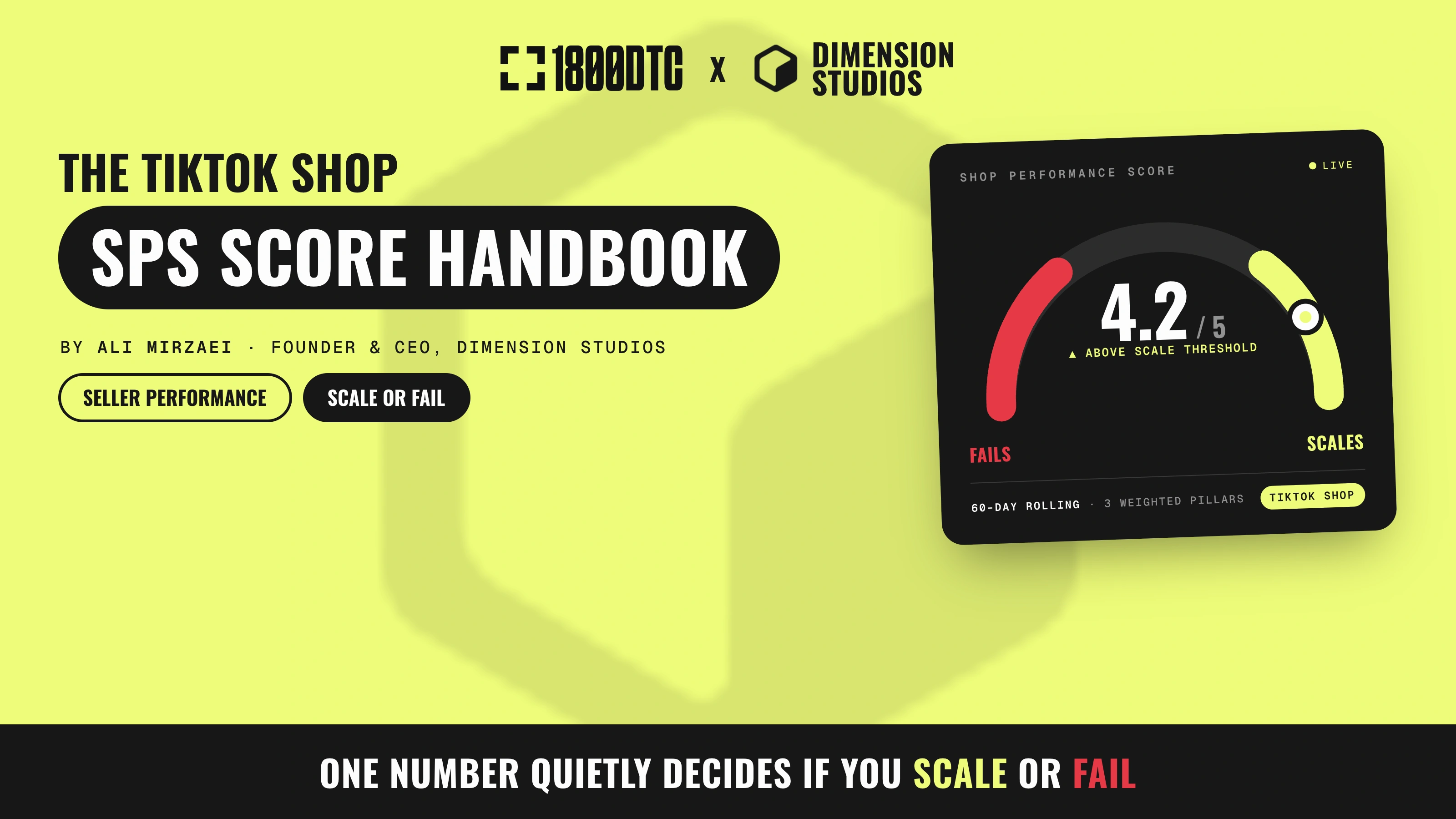
The TikTok Shop SPS Score Handbook: How One Number Quietly Decides Whether Your Shop Scales or Fails

Ali leads Dimension Studios, the AI operating system for TikTok Shop. He has built four #1 brands in their categories (including the platform's #1 overall shop), shares his expertise with clients to keep them profitable from launch, and helps power agencies running 100+ shops.
3 Key Takeaways
- SPS is the single most underestimated metric on TikTok Shop. It silently gates algorithm visibility, affiliate access, Shop Ads eligibility, and your real unit economics. Most learn this the hard way, after the shop is already throttled.
- The score is a dynamic 0-5 rating built on a 60 day rolling window across three weighted pillars. A single bad two week stretch can wipe out months of growth because TikTok throttles before it tells you.
- Monitoring SPS reactively is already too late. The shops that compound on TikTok Shop run predictive systems on the input metrics (customer support satisfaction, fulfillment SLA, product satisfaction) that move SPS before the score itself moves.
The Day a Seven Figure Shop Went to 80% Throttled in Twelve Days
In January, one of the shops we manage was doing consistent 5 figure days. Twelve days later, daily GMV had collapsed by roughly 80%. Same product. Same creatives. Same affiliate roster. Same ad budget.
What changed was a number most operators never look at until it's already broken: the Shop Performance Score, or SPS.
A short fulfillment backlog from a 3PL transition pushed late shipments up. A handful of negative reviews stacked on a hero SKU. Customer service tickets piled up over a long weekend. None of it looked catastrophic in isolation. But TikTok's algorithm doesn't read incidents in isolation. It reads SPS. And once SPS slipped below the threshold the algorithm uses to decide which shops get distribution, the shop wasn't punished, it was simply made invisible. Fewer affiliate match ups. Fewer organic impressions. GMV Max ads campaigns wouldn't spend budgets.
I've spent the last two years building Dimension Studios specifically because the gap between what you'd expect to drive growth and what truly dictates it is wider than any other channel I've seen. SPS sits at the center of that gap. If you don't understand it, you'll eventually hit a wall you didn't see coming. If you do understand it, you can compound on the platform while your competitors get throttled and quit.
This is the handbook I wish someone had handed me on day one.
What SPS Actually Is (and What Most Operators Get Wrong)
SPS is a dynamic 0 to 5 score TikTok assigns to every active shop. It refreshes daily, runs on a 60 day rolling window, and gets calculated across three weighted pillars:
| Pillar | What it measures | Common inputs |
|---|---|---|
| Product Experience | How customers feel about what they received | Review average, return rate, defect rate, counterfeit and IP claims |
| Logistics Experience | How fast and consistent the shop delivers orders | On time dispatch and ship rate, on time delivery rate, speed of delivery |
| Customer Service Experience | How customer service is perceived and rated | Response time, refund rate, customer satisfaction from support |
The weights skew as follows. Product experience holds the most weight, logistics follows closely, and customer service experience comes last. Categories are also held to their own standards, rather than a platform wide benchmark.
A shop typically needs around 30 orders before TikTok publishes a score at all. Below that threshold the shop sits in a kind of probationary state and any single signal looks larger than it is. That's why new shops can launch with a hot week and then watch their SPS swing wildly. It's not a bug. The denominator is just small.
Here's the part most brands and agencies get wrong:
SPS isn't a quality score. It's the platform's permission slip for every distribution channel you have.
A 4.6 doesn't mean your products are “pretty good.” It means TikTok has graded you as a shop it can confidently route demand into. A 3.8 doesn't mean your products are bad. It means TikTok will quietly stop sending you traffic until you fix it.
The score isn't just feedback for the merchant. It's a routing input for the algorithm.
Once you internalize that, the way you operate the shop changes.
The Hidden Link Between SPS and Your Unit Economics
Most TikTok Shop unit economics conversations focus on the visible costs: TikTok's commission, affiliate commission, ad spend, fulfillment, COGS, returns. Those are the obvious P&L lines.
SPS is the invisible one. It moves your real take rate without ever showing up on an invoice.
A shop with strong SPS gets organic impressions, affiliate prioritization, and GMV Max spending at full strength. Demand is plentiful, so the brand can afford to run more hero SKUs, avoid high commission deals, and pass on expensive retainer partnerships that don't pencil out.
A shop with weak SPS has the opposite problem. Organic distribution dries up. Affiliates with options won't promote it. To replace lost volume, the brand starts paying for it: higher commission tiers, deeper discounts, lower GMV Max ROI, paid creator placements that should have been organic, more aggressive ad bids. The cost of every sale climbs. Returns and refunds (already a drag) hit a smaller revenue base. Take rate compresses.
I've watched directionally healthy and well run TikTok Shops collapse inside a week, purely on the back of an SPS slide. The brand never changed its winning strategy. The platform just changed the price of distribution.
If you only remember one thing from this piece: SPS isn't a marketing metric. It's a margin metric.
How SPS Gates Your Affiliate Program
The thing that breaks operators' brains is that on TikTok Shop, the affiliate ecosystem is where most of the volume lives, and the affiliate ecosystem is gated on SPS.
It works roughly like this. Smaller creators (the bulk of affiliate applications most shops see) can find your shop in the open marketplace. They're easy to recruit and they convert at low volumes. The creators who actually move GMV, the ones with real audiences and real conversion track records, live in a more curated browsing experience. TikTok sorts which shops they see by SPS tier.
In practice, that means a shop sitting at 4.2 sees radically less affiliate inbound interest than a shop sitting at 4.7. Not double. Not triple. Often an order of magnitude less. Same products. Same commissions. Same outreach effort. The platform is just routing creator attention elsewhere.
The follow on effect is the part most people miss. If your affiliate pipeline shrinks, your content velocity shrinks, and content velocity is the input that drives organic GMV. Lower SPS becomes a punishing loop: less affiliate match volume leads to less content, which leads to fewer reviews, which leads to weaker product experience signals, which leads to lower SPS.
The shops that win this loop don't try to recover from it. They never enter it.
The Four Operational Levers That Move SPS Fastest
After running multiple top ranked shops on the platform, here are the levers that move SPS fastest, roughly in the order of leverage we see:
- Customer service response time. Sub two hour median response inside the platform's chat tool, ideally faster. This compounds your customer service experience harder than anything else, as customers value quick responses to concerns and inquiries.
- Fulfillment SLA discipline. On time ship rate matters more than fast ship rate. A shop that ships in 48 hours every time beats a shop that ships in 24 hours sometimes. Predictability is what gets scored.
- Review velocity on hero SKUs. A high cadence of positive reviews on your top three SKUs pulls product experience up faster than spreading review velocity across the catalog. Leverage incentives like review coupons to drive your numerator up faster.
- Refund rate triage. The fastest unforced error on TikTok Shop is letting refunds sit unanswered for long periods. Tighten return policies, fix listing accuracy, and address return and refund requests rapidly.
Notice what's not on this list: discounting, more ads, more affiliates, more creatives. None of those move SPS. They move GMV in the short term while the underlying score continues to deteriorate. Which is exactly how shops end up dead.
What a “Good” SPS Actually Unlocks
This is the table most operators have never seen, because TikTok doesn't publish it cleanly anywhere. Directionally, here's what we observe at different SPS tiers:
| SPS tier | What it unlocks |
|---|---|
| Below 3.0 | Warnings, suspensions, loss of affiliate sampling privileges |
| 3.0 to 3.9 | Basic deboosting, severe throttling on organic and affiliate distribution |
| 4.0 to 4.4 | Shop Ads campaigns unlock, baseline affiliate visibility |
| 4.5 to 4.6 | Healthy organic distribution, broader affiliate browse, growing creator inbound |
| 4.7+ | Top tier creator magnetism, Mega Sale and category campaign invitations |
| 4.8+ | Premium surface placement, traffic boosting, SKM partnership routing, direct attention from TikTok category teams |
The jump from 4.4 to 4.8 is the single most valuable margin in TikTok Shop operations. It's the gate between “running a shop” and “compounding on the platform.”
The Predictive Operating System: Why Monitoring SPS Itself Is Already Too Late
Here's the operational truth that took us the longest to figure out, and that almost no shop runs against today:
By the time SPS moves, you're already two to four weeks late.
The score is a lagging indicator. It reflects 60 days of operational behavior. If your fulfillment partner started slipping on Monday, you won't see SPS move until late the following week. By the time you see it, you've already lost distribution, you've already lost affiliate traction, and you've already started the spiral down.
The shops that compound on TikTok Shop don't monitor SPS. They run the same four levers above as live inputs, on much tighter cadences:
- Median customer service response time, hourly
- On time ship and on time delivery rate by warehouse, daily
- Review velocity and sentiment on hero SKUs, by day
- Refund and contact rate spikes at the SKU level
When any of those move, you have roughly a two week head start before the score moves. That's the window in which good operators fix things. By the time the score moves, you're climbing the mountain.
This is the operating system we build into every shop we run, and it's the reason a brand can compound through the kind of incident that took the shop I opened with from 5 figure days to 80% throttled GMV in twelve.
The lesson from that recovery: SPS isn't something you check. It's something you operate against, every day, on inputs that show up before the score does.
Read More on TikTok Shop: TikTok Shop Affiliates vs. Paid Creator Partnerships
Join 17k+ subscribed
Get The eCommerce Pulse
The twice-weekly briefing for operators, founders, and partners shaping modern DTC.