Marissa O'Halloran is the Commerce Lead of 1800DTC. When she's not researching and writing about the latest DTC products and brands, you can find her hunting down the best matcha in town, overpacking her carry-on, or hanging out with her golden retriever, Pepper.
Every fashion founder knows video works. The data isn't subtle. Product pages with video convert 65% higher than image-only pages. That's not a rounding error. That's the difference between a brand that scales and one that stalls.
So why are most fashion brands still running static image PDPs on 80% of their catalog?
Because traditional video production doesn't scale. A single shoot with a model, photographer, studio, and editing runs $500 to $2,000 per SKU on the low end. If you have 300 products, that's $150K to $600K before you've filmed a single Reel or ad variant. And by the time the shoot is done, two colorways are out of stock and the season's half over.
AI-generated video changes that math entirely. We're talking 5-6% of the cost, produced 100x faster, with enough output to cover every PDP, every channel, and every paid campaign, without a studio booking or a single model callback.
The brands figuring this out right now are building a content infrastructure their competitors won't be able to catch up to for years. This guide is the practical playbook: what video types you actually need, how to build a workflow that goes from product photos to everywhere, and what to look for in a tool that won't make you rebuild your stack in 12 months.
Why Fashion Brands Need Video on Every PDP
Static images have a conversion ceiling. At some point, a shopper looking at a flat-lay of a linen blazer or a studio shot of a slip dress has to make a leap of faith. What tends to happen is they bounce. Or worse, they buy, it doesn't meet expectations, and they return it.
Return rates in fashion average 25–30%, with some categories and retailers reaching 40% and expectation gaps drive most of that. The shopper imagined how the fabric would move, how the fit would land on their body, how the drape would look in motion, and the product didn't match the image in their head. Video closes that gap.
What static images physically cannot communicate:
Fabric drape and weight (does that midi skirt swish or fall stiff?)
Movement and stretch (will those pants move with you or fight you?)
True fit and proportion (how does this boxy cut actually sit on a body?)
Texture depth (is that "ribbed" knit subtle or chunky?)
Video answers all of these before the customer asks. And when customers don't have to guess, they buy with more confidence and keep what they buy.
The conversion lift numbers from real implementations back this up. VideoPoint's shoppable video data shows +24% conversion and +21% revenue lifts on fashion PDPs with embedded video. That's not a niche result. That's repeatable across product categories when you give customers the visual information they need to say yes.
There's also a compounding SEO and ranking benefit. Google increasingly surfaces video-rich product pages through rich results, and brands with proper video schema markup see measurably higher click-through rates in shopping results.
Not all video is created equal, and "just add video" isn't a strategy. Different formats serve different conversion moments. Here are the five video types that actually move the needle for fashion brands and where each one fits in your funnel.
1. Runway and Lookbook Videos
These are the anchors of your PDP video strategy. AI-generated model movement showing garments in motion. A jacket shrugging onto shoulders, a dress hem catching stride, a set moving together in a real walking sequence.
The use case is straightforward: these live on your PDPs and collection pages as the primary video asset. They replace the "wish we had video" note in your production backlog and give every SKU the runway treatment, even your basics.
What makes them convert: movement shows fit, drape, and proportion in a way that no amount of studio photography can approximate. A shopper watching a dress move on a model gets an intuitive understanding of how it'll feel on their own body.
2. 360-Degree Product Spins
Ghost mannequin and product rotation generated from your existing flat-lay photos. These give shoppers the ability to see a product from every angle; seams, construction, hardware, and back detailing all without a multi-day studio setup.
These are best deployed as a secondary view on PDPs alongside your runway video. They're especially high-value for structured pieces (blazers, bags, footwear) where construction and finish are purchase drivers.
The production math here is where AI earns its keep. Generating 360 spins at scale from existing product photography is the kind of task that would require a lightbox studio setup and days of post-production at traditional costs, or just a few hours of AI generation.
3. Multi-Model Fit Previews with AI Avatars
The same garment shown in motion on AI-generated avatars across different body types, skin tones, and proportions. This is the video format most directly tied to return rate reduction – the quiet margin killer most fashion brands don't fully account for.
Most brands can only afford to shoot one model per SKU. That means the entire catalog represents a single body type. AI avatars fix that – a single set of product photos generates video across a range of representative bodies, no extra shoots or casting calls. Every SKU gets diverse representation as a default, not a luxury.
When a shopper sees how a silhouette lands on a body similar to theirs, they're not guessing. They're making an informed choice. Use these on PDPs alongside size guides. Brands using avatar-based fit previews consistently see meaningful drops in size-related returns, which compounds into better margins, better reviews, and lower customer service load.
4. Social-First Short-Form (Reels and TikTok)
This is your PDP content repurposed for social distribution. Everything formatted, cropped, and paced for Instagram Reels and TikTok. The AI-generated clips that work here aren't long-form lookbooks. They're 7-15 second loops: a garment in motion, a close-up texture pull, a fit reveal.
The workflow unlock is that you're not creating separate social content from scratch. You're pulling from the same video generation pipeline that produces your PDPs, reformatting for vertical, and distributing. One production run, multiple distribution channels.
Brands that nail this use Reels not just for organic reach, but as the top-of-funnel entry point that drives to shoppable PDPs. The video a customer sees on Instagram is the same asset of what they see when they land on the product page. Consistent visual language from discovery to purchase.
5. Shoppable Video Ads
Interactive video ads with embedded product tags is the format that closes the loop between content and commerce. A shopper watches a short video, taps a product they like, and lands directly on the PDP. No friction, no search, no navigation.
These are purpose-built for paid social and retargeting. They work because they meet the customer exactly where they already are (scrolling Instagram, watching a TikTok) and convert that attention directly into a purchase moment.
VideoPoint's shoppable video infrastructure is purpose-built by generating the video creative that feeds into Meta/TikTok's native shopping ad formats without requiring a separate creative production workflow.
Here's the real value proposition. You don't need a separate production pipeline for PDPs, another one for social, and another one for ads. One workflow, one set of source assets, every channel covered.
This is what it looks like in practice for a fashion brand on Shopify:
Step 1: Start with what you already have. Your product data are already in Shopify. That's your source material. AI video generation doesn't require a new shoot, it generates video from existing photography. The images you've already paid for become the input for every video format you need.
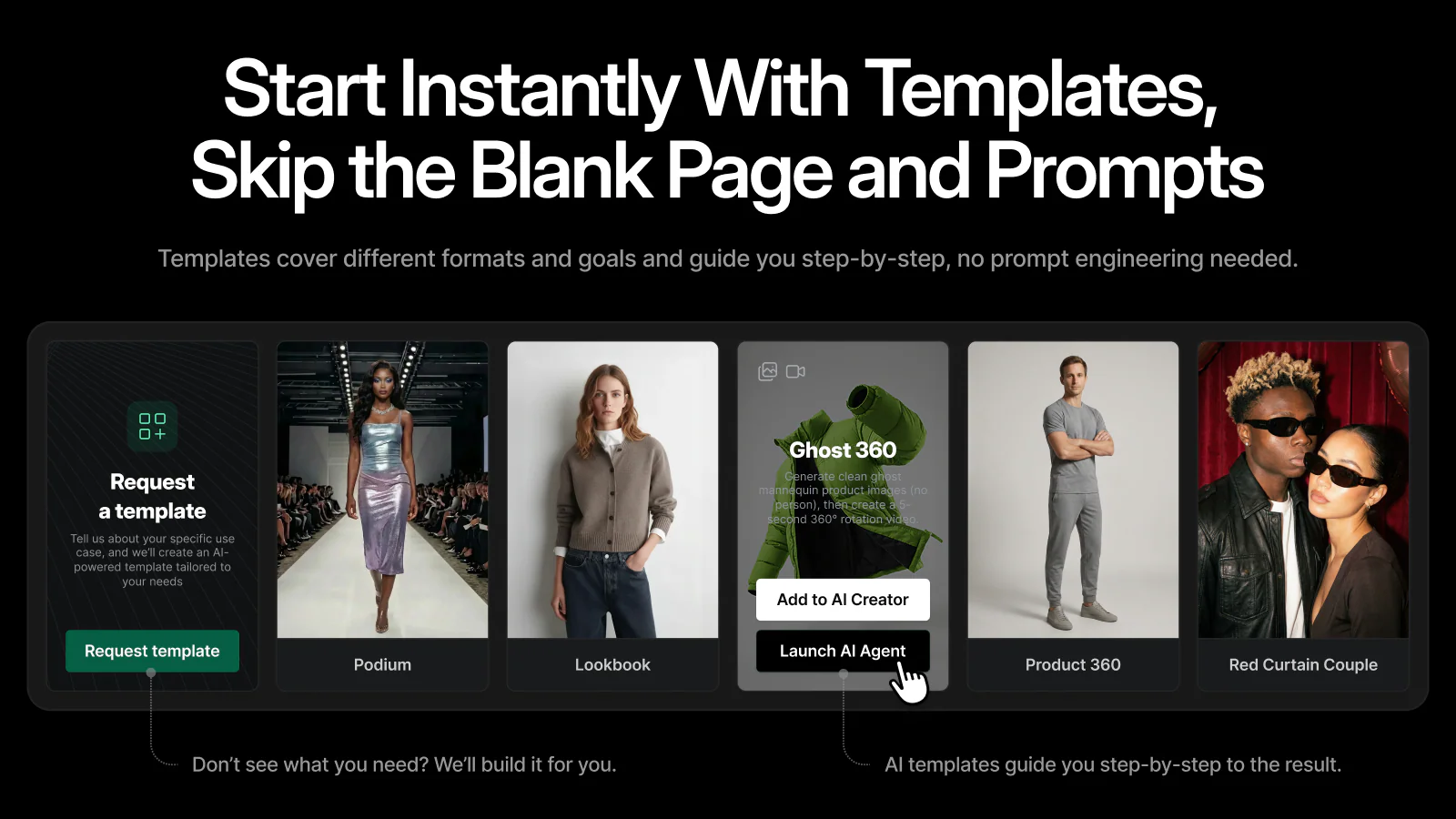
Template previews from VideoPoint
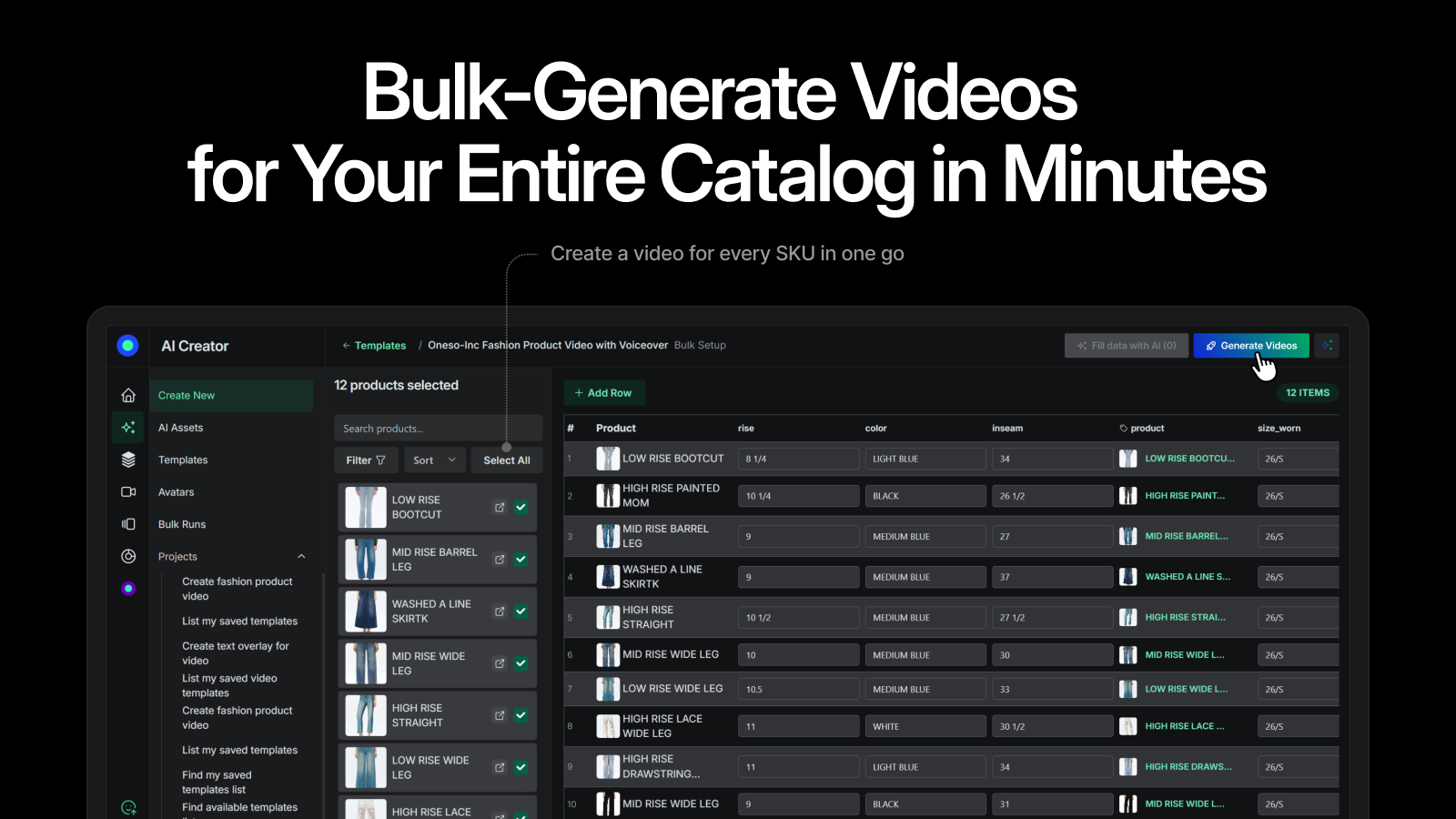
Step 2: Bulk generate across your catalog This is where the math flips. Traditional production forces you to prioritize which 50 SKUs get video. AI generation lets you do the whole catalog. 500 SKUs doesn't require 500 individual decisions. You run it in bulk, you review outputs, you publish.
The production cost comparison is worth spelling out plainly: 500 SKUs at $500/video traditional production = $250,000. AI-generated alternative = a fraction of that, delivered in days, not the months a traditional shoot schedule would require.
Preview of the VideoPoint dashboard for bulk generating videos
Step 3: Embed shoppable video on PDPs Generated videos go directly onto product pages as the primary media asset. Stories, Highlights, Carousel, and Landing Page formats all get the assets. VideoPoint's Shopify integration handles the embed natively so you're not porting files between platforms.
Step 4: Auto-export to Instagram and TikTok The same content pipeline that generates your PDP videos exports social-formatted versions directly to Instagram Reels and TikTok. No manual cropping, no aspect ratio math, no separate upload workflow.
Step 5: Push to Ads Manager Your shoppable video assets move into paid campaigns within Meta Ads Manager for paid social and retargeting. The video-to-ad pipeline stays inside the same ecosystem rather than jumping between tools.
There are a growing number of AI video tools in the market. Most of them are general-purpose. Fashion e-commerce has specific requirements, and the wrong tool creates more work than it saves. Here's what actually matters:
Native Shopify integration: The tool should live inside your existing stack, not alongside it. If you're exporting files, uploading manually, and managing a second platform, the workflow friction will kill adoption. Native Shopify integration means your product catalog is already there, your videos publish directly, and your analytics connect to your actual sales data.
Bulk generation capability: One-video-at-a-time tools are not a solution for catalog-scale content needs. You need a tool built to process multiple SKUs in a single run. Anything less and you're still making prioritization decisions about which products deserve video, which ultimately defeats the point.
Fashion-specific templates: Generic AI video tools produce generic-looking video. Fashion has specific visual language: runway movement, lookbook pacing, editorial framing, try-on context. A tool built with fashion-specific templates will produce output that fits your brand aesthetic; a general-purpose tool will require significant post-production to get there.
Built-in shoppable commerce layer: Passive video is a missed opportunity. The tool should embed product tags, click-through links, and purchase paths directly into the video experience. Video that converts to sales is categorically different from video that generates views.
Conversion analytics and revenue attribution: You need to know which videos are driving sales, not just which ones are getting played. Revenue attribution at the SKU level is what separates a content investment from a content experiment.
Social distribution pipeline: Direct export to Instagram Reels, TikTok, and Ads Manager all built into the tool, not a manual step. If your video tool doesn't handle distribution, you've only solved half the problem.
VideoPoint is built specifically against this checklist. Shopify-native, bulk generation, fashion-specific templates (Runway Walk, Ghost 360, Street Portrait, Product 360, and more), shoppable video with embedded product tags, revenue attribution dashboard, and social distribution pipeline. It's purpose-built for fashion e-commerce, not adapted from a general-purpose video tool.
[single-inline-tool]
Summary: AI Video for Fashion E-Commerce Window Is Now
The fashion brands that move on AI video in 2026 aren't just solving a production budget problem. They're building a content infrastructure that compounds. More video means better conversion. Better conversion means more data. More data means smarter optimization. And a catalog that's fully video-enabled through its PDPs, social, and ads is simply harder to compete against than one that isn't.
The cost barrier that kept video production as a premium-only play is gone. The workflow barrier that made catalog-scale production impossible is gone. What's left is execution.
Ready to see what AI video looks like for your catalog?Try VideoPoint free! This AI video platform is built for fashion brands on Shopify. Start instantly with the templates and generate your first videos from your existing product photos and videos in minutes.
VideoPoint is an AI video creation platform that helps Shopify brands produce shoppable videos fast and at a fraction of traditional production cost. Create and publish videos across PDPs, collections, and landing pages to lift conversion with instantly shoppable experiences. No prompt engineering required: guided AI templates walk you step by step, and you can generate videos in bulk using your product data to cover your entire catalog in minutes. Localize your creative with pre-made or custom avatars for different audiences, all in one chat workflow with templates, voice input, and best-in-class AI models. Track results with built-in analytics that measure engagement, conversion, and revenue impact.