TikTok Shop Affiliates vs. Paid Creator Partnerships: When to Use Each (and Why You Probably Need Both)

Working in ecommerce for 10+ years, Josh is the founder of Aligned Growth Management. Today, AGM helps brands of every size, from scrappy startups to the names you already know, scale influencer marketing that actually drives revenue.
Key Takeaways
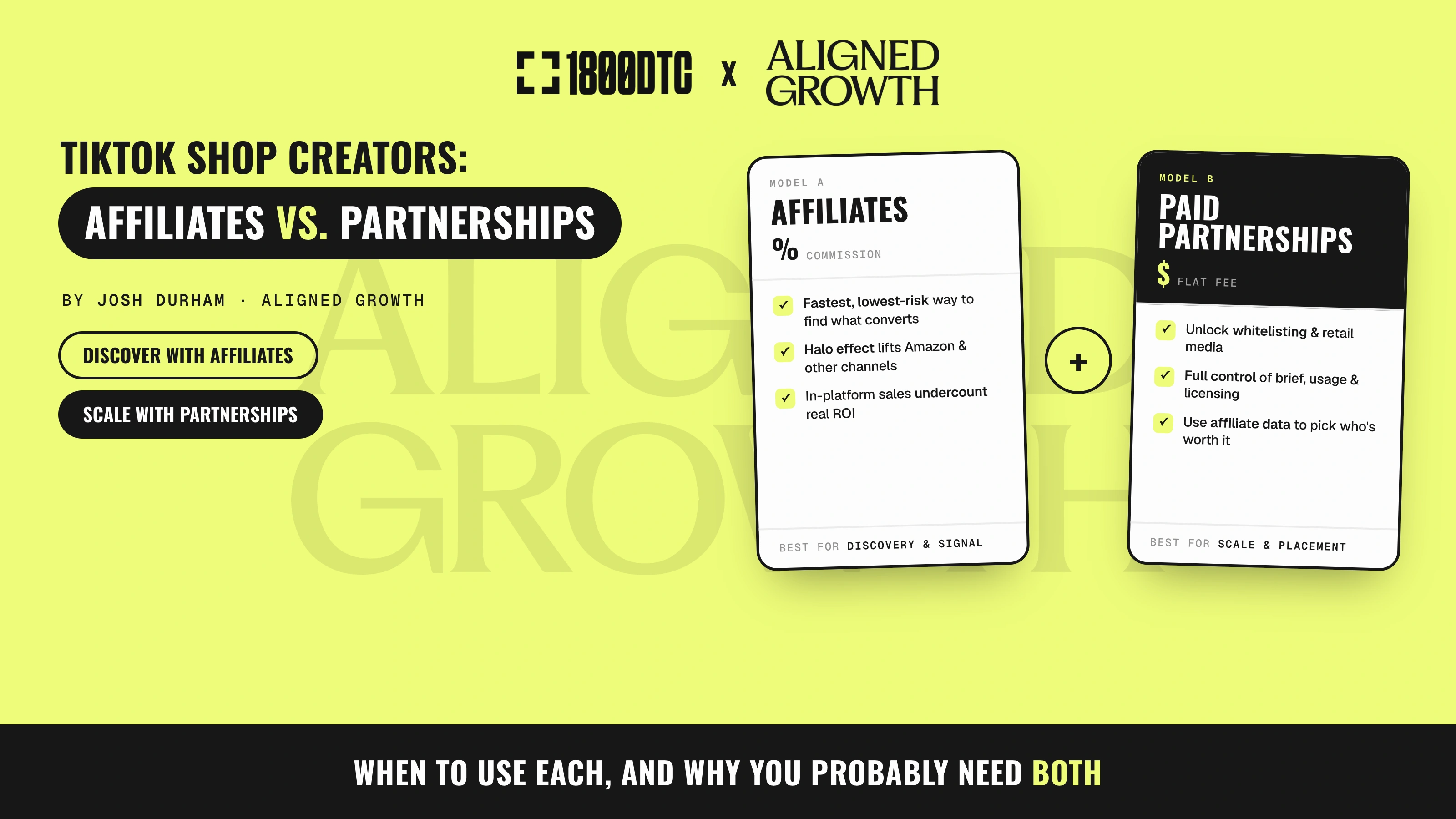
● TikTok Shop affiliate is the fastest, lowest-risk way to find out which creators and content angles actually convert for your product, but the value extends far beyond what TikTok's own dashboard shows you.
● Affiliate activity creates a measurable halo effect on Amazon and other channels, meaning brands that only track in-platform sales are significantly undercounting their real ROI.
● Paid partnerships unlock whitelisting and retail media placements that affiliate relationships structurally cannot provide, and the smartest brands use affiliate data to decide which creators are worth that investment.
Brands we onboard often ask some version of the same question: should we be doing TikTok Shop affiliate, or paid creator partnerships?
It's the wrong question. This isn't an either/or decision. It's about identifying which problem you're solving right now and matching it to the right channel.
Below, we break down what each model is actually built for, why the most overlooked metric in TikTok Shop strategy is what's happening on Amazon, and how we sequence the two together for clients to get the most out of both.
The Affiliate Model: Built for Volume, Not Control
TikTok Shop affiliate is the newest affiliate / influencer model that has been exploding for tons of DTC brands.
You set a commission rate, creators pick up your product organically through the Shop tab or by request, they post, and you pay out only on conversions tied to that post.
No upfront fees. No negotiation. No briefing thirty creators individually. The system does the matching for you, and your CAC is tied directly to performance.
This is why affiliate-first is usually the right starting move for brands new to creator commerce. You're not paying for reach you can't measure, but you are paying for outcomes.
The tradeoff is just as real. You don't control who picks up your product, how it gets framed, or when it posts. A creator with 4,000 followers might post and go nowhere, while one with 800 followers catches an algorithmic wave and generates $50k in sales.
It's a numbers game that rewards brands comfortable seeding a massive amount of product widely and letting the platform sort winners from the noise.
We've watched clients go from a handful of organic affiliate posts to hundreds of creators picking up product in a single month, with zero outbound effort required. That's the flywheel working as designed.
The Halo Effect: Where Affiliate Revenue Gets Interesting
Here's the part most brands miss, and it's why we never evaluate TikTok Shop affiliate purely on its own attributed revenue numbers.
When creator content about your product circulates at volume on TikTok, it doesn't just drive in-app purchases. It drives brand search. People see a product in their feed, don't buy in the moment, and then check it out on Amazon later that day or week.
We've seen this pattern repeatedly: a spike in TikTok Shop affiliate activity correlates with a lift in Amazon organic traffic and conversion rate for the same SKU, even with no direct link between the two. TikTok isn't just a sales channel for a huge percentage of consumers. It's a discovery and validation layer that sits in front of the purchase decision, regardless of where that purchase actually happens.
This changes how you should measure ROI. If you're only looking at TikTok Shop attributed revenue and ignoring the lift on Amazon, branded search volume, and direct site traffic, you're dramatically undercounting what affiliate activity is actually worth.
So instead of asking "what's our TikTok Shop revenue," ask "what's happening to our Amazon and DTC numbers when affiliate volume goes up." That's usually where the real payoff shows up, and it's the argument that gets the affiliate budget protected when a finance team wants to cut a channel that looks unimpressive in isolation.
Paid Partnerships: Built for Control and Access Affiliate Can't Touch
Paid creator partnerships solve a different problem entirely. You're not paying for volume. You're actually paying for control: who represents your brand, what they say, when they post, and what you're allowed to do with the content afterward.
Two things become possible here: whitelisting and retail media integration.
Whitelisting / paid partnership ads means the brand runs paid ads through the creator's handle instead of its own. This past year, we've seen a huge growth in partnership ads as Meta started to prioritize that type of content in the algorithm. Ads that look like organic creator content consistently outperform brand-run ads on cost per click and cost per acquisition, because they don't read as advertising. They read as a recommendation. This requires a contract and the creator granting ad permissions to your ad account, which is a paid partnership deliverable, full stop.
Retail integration is becoming a bigger conversation every quarter. Amazon's Creator Connections program, retail media networks, and on-site placements that pull from creator content all require usage rights affiliate relationships don't grant by default. If you want a creator's video running as a sponsored ad unit on a retailer's site or embedded in a product detail page, you need a paid agreement with explicit licensing terms. That content is built to be repurposed across paid channels for months, not a single organic post with a short shelf life.
Paid partnerships also buy you creative control. If you have a specific message to land, a launch to time precisely, or compliance language that has to be included, you need a brief and a contract, not an open affiliate program where you're hoping someone tells the story the way you need it told.
Why You Need Both, and How We Sequence It
The brands that win on TikTok Shop long-term aren't choosing affiliate or paid. They're running both, with each funding decisions about the other.
Start with affiliate to find your organic winners. Let the algorithm and the open marketplace tell you which creators, hooks, and product angles actually convert, without spending a paid dollar to find out. The data from affiliate performance is some of the cheapest market research available to a DTC brand right now.
Once you've identified creators whose content is outperforming, that's your shortlist for paid conversations. You're not guessing who might resonate with your audience. You have proof. Now you go to them with a whitelisting agreement, a usage license, or a retainer, locking in upside you already saw for free and unlocking distribution affiliate alone could never give you.
This also solves a common budget objection. Clients nervous about paid spend can de-risk that decision by letting affiliate performance be the audition. Nobody gets a paid contract without showing organic traction first, which is a much easier number for a CFO to sign off on than a cold paid placement based on follower count alone.
It works in reverse too. A creator performing well in a whitelisting partnership is a signal to open the door for more affiliate activity from creators in a similar niche or tier. Treating affiliate and paid as separate line items, run by separate teams with no shared reporting, is the single biggest reason brands leave money on the table.
The Final Take
Affiliate gets you reach, real-time market data, and a flywheel that compounds with minimal management overhead, plus a halo effect that shows up in places you're not directly measuring, like Amazon. Paid partnership gets you control, ad-ready content through whitelisting, and access to retail placements that require licensed usage rights affiliate structurally can't provide.
If your strategy is only affiliate, you're leaving performance media and retail integration on the table. If it's only paid, you're spending more than you need to in order to find creators who could have proven themselves for free first.
Run both!
Expertise Behind the Piece: More about Josh Durham & Aligned Growth Management
With TikTok Shop exploding, there are a lot of questions brands want to know about, including this topic on affiliate vs. paid creator partnerships. To help share insight on this, the 1800DTC team touched base with someone who can provide valuable insight. Running Aligned Growth Management since 2020, Josh Durham filled the shoes.
Josh started a weighted blanket brand out of his parents' garage in college. Year one: $30K. Year four: $6.5M. The growth engine behind it was influencer marketing.
He took that playbook and built Aligned Growth Management around it. Today, AGM helps brands of every size, from scrappy startups to the names you already know, scale and optimize influencer marketing that actually drives revenue and grows DTC/CPG brands.
FAQs
Do I need a minimum budget to start with TikTok Shop affiliate?
No. Affiliate is commission-based, so there's no upfront media spend required to get started.
How do I measure the halo effect if TikTok doesn't report it?
Track branded search volume, Amazon session and conversion data, and direct site traffic alongside TikTok Shop activity, then look for correlated spikes during high-affiliate-volume periods.
Can I whitelist a creator I found through affiliate?
Yes, but it requires a separate paid agreement granting ad permissions. Affiliate participation alone does not include whitelisting rights.
Read More on TikTok Shop: The TikTok Shop SPS Score Handbook, Scaling or Failing
Join 17k+ subscribed
Get The eCommerce Pulse
The twice-weekly briefing for operators, founders, and partners shaping modern DTC.