The 5 Questions DTC Brands Ask Agencies in Discovery Calls

Travis Halff is the founder and owner of Y'all, a boutique performance creative and digital marketing agency that helps DTC brands scale their paid acquisition channels. Y’all is a nod to Travis’ Texas roots and a reminder that great marketing starts with understanding and connecting with your audience, your “Y’all.”
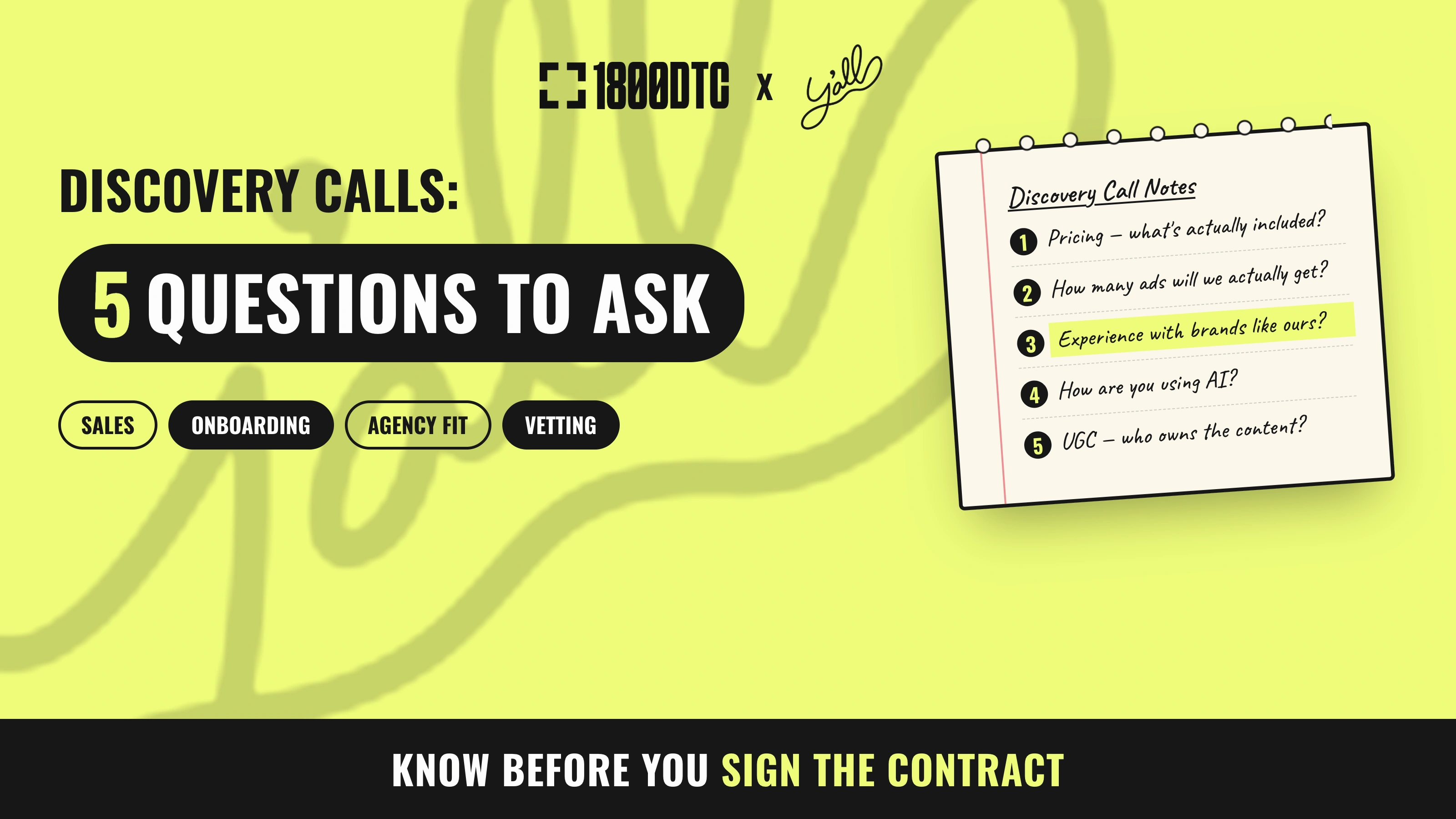
As the founder of a boutique performance creative agency, Y’all, I run all discovery calls with potential clients. I get a good sense of what folks are focused on at any given moment based on the first questions they ask me. During these conversations, I talk to all sorts of DTC brands: food and beverage, health clinics, home goods companies, accessibility tools, supplements, and more. Some of the brands are pre-rev and just starting their DTC journey, while others are spending over a million per month on ads.
About two-thirds of the calls are brands that had worked with an agency before and were unhappy with it. The rest are brands that had been doing everything in-house and were now considering bringing in an agency partner for the first time. The same five questions come up in almost every conversation. I’ve broken each down, along with how I respond.
"What's your pricing, and what's actually included?"
I'm including this question first, since even though it's often the final question in my discovery calls, it’s clearly at the front of everyone's mind. It makes a lot of sense. Agency fees can hinder growth and cost brands dearly when the contribution to your brand's growth is misaligned. If there is alignment between the agency and the brand's long-term goals, those fees feel like a drop in the bucket.
Agencies approach pricing in wildly different ways depending on services offered and value proposition, so I can only speak to the system that we've found provides the best value to our clients. At Y'all, we scale brands through their paid acquisition funnel, developing a creative flywheel that supports increasing ad spend, reaching new customers, and bringing back learnings from every ad, all while keeping a close eye on our clients' MER (Marketing Efficiency Ratio).
That alignment principle shows up in how we structure pricing too. For brands spending under $100K a month on ads, we run a $10K monthly retainer that covers the creative flywheel:
- structurally distinct concepts produced across static, animated, video, and UGC formats
- the cost of working with our roster of creators
- usage rights in perpetuity on any UGC we produce
As ad spend grows past $100K, the retainer scales up alongside it to match the volume and complexity the account needs at higher spend levels.
For brands above $200K a month who engage us for media buying alongside the creative, we often shift to a percent-of-spend model. With both creative and media tied together at that scale, the work and the value move in lockstep. Tying our fee directly to spend further aligns the incentives. We only make more when the account is actually growing, and we share in the downside if it isn't.
The push I'd give you with any agency you're evaluating is to look closely at how their fees behave when the account does. Ask what happens to their billing if your spend doubles, and what happens if it halves. The answers will tell you whether their incentives are pointed in the same direction as yours.
"How many ads will we actually get?"
For a long time, volume was how agencies competed on discovery calls, and for some agencies, it still is. 50 ads a week, 100 a week, 200. Whoever quoted the bigger number won the pitch, regardless of the creative diversity in the ad deliveries. That worked back when Meta still distinguished between variants and gave you data back on each of them. After Andromeda, those minor variants collapse into the same impression, and most of the agencies still leading with old-school volume numbers are basically producing one ad fifty times and calling it fifty ads.
The way we think about volume at Y'all is in terms of net new ads. Every non-iteration ad we produce is visually distinct enough that Meta reads it as something new. We don't do variants. We don't do headline testing in the traditional sense. What we're testing instead are different combinations of messaging angles, personas, and formats, and we use the data from those tests to decide what's worth iterating on. Iterations on winners are then deployed after that critical groundwork is done.
For brands spending between $50K-$150K per month, that lands somewhere in the range of 30 to 50 net new ads per month, depending on the account and how much iteration is happening on existing winners. Caveat of all caveats: this varies wildly by brand, so please take it with a grain of salt and make sure the agencies you are talking to look at your specific needs before throwing out a concrete number. As brands spend more and reach more audiences, the number of ads increases.
If you're comparing agencies on volume, the more useful question is how many of those ads Meta will actually read as net new.
"Do you have experience with brands like ours?"
So what this question is really getting at is ramp time. The unspoken half is "how long until you actually understand what we do," because the brand has usually either spent six months teaching their last agency the business or has heard enough horror stories from peers to want to avoid that pattern.
Where we have the deepest experience at Y'all is in DTC food and beverage, health and wellness, and the broader "better-for-you" CPG space. That's kind of where a lot of the momentum is in DTC right now, and it's where the team is sharpest. We also intentionally keep some clients outside our core verticals, because the cross-pollination tends to sharpen the work in our core categories. And when a brand comes to us from a category we haven't worked in directly before, the approach is creative strategy first, since the "we know exactly what you need" pattern is what gets agencies in trouble fast.
We also work with a smaller number of clients than most agencies our size. The reason is that we really only want to take on engagements where we feel confident the team can meaningfully move the needle for the brand.
The version of this question I'd push on any agency you're considering is whether they've ever turned down a brand in your category, and what their reasoning was. A long client list tells you what an agency is willing to sell to. A turned-down deal tells you where they've decided they can't do their best work, which can be a more useful piece of information.
"How are you using AI?"
The way we think about AI at Y'all is that it should enhance the work the team is already doing, not substitute for the critical thinking that makes the work good in the first place. Every designer is trained on the current generation of image and video models, and gets retrained when new ones ship. We use generation tools to push creative further than we could on our own. We use AI to do research at scales that used to require a small army.
On the back end, we use it for ad comment analysis, creative tagging through tools like Motion, and review mining. We're testing ChatGPT ads as a paid channel, and we have an AI discovery team focused on how our clients are showing up in LLM-driven search results, which is becoming a meaningful acquisition channel faster than most brands realize.
What we don't do is hand the strategy or the creative direction over to AI and let it run unsupervised. The tools are powerful, but they don't have the judgment to decide which message is going to land with which audience and why.
The picture gets more complicated in health and wellness, where a huge portion of our client base sits. Poor AI use in that space can break consumer trust immediately. A synthetic-looking creator, an AI-generated before-and-after, an unrealistic claim phrased in a way only an LLM would phrase it, any of those can sink an ad faster than a bad offer would. That's why we advise health and wellness brands against AI UGC entirely, and to take great caution when using it in ads. The risk of an audience clocking something synthetic and tanking performance is too high to justify.
Beyond the trust issue, there's now real legal exposure to think about. New laws are rolling in that require explicit disclosure of AI use, the first out of New York, and that regulatory layer is going to keep expanding. For brands in regulated categories, the right answer to "how are you using AI" is: carefully, transparently, and with documentation showing what was used and where.
If you want a quick way to gut-check any agency on this, ask them to show you a recent ad where they used AI and walk you through what the AI replaced. If you're in health and wellness, also ask how they handle disclosure.
"How does UGC work, and who owns the content?"
This question is almost always about ownership and rights, and the brand asking it usually has a specific bad experience behind it. A campaign that was working, a piece of UGC carrying the spend, and a licensing window expiring at the worst possible moment. Creator agency fees that doubled the second the ad started working. Whitelisting agreements that lapsed without warning.
The way we've structured UGC at Y'all is built around removing that risk. We work with creators rather than influencers. This means smaller followings, lower fees, and content that comes across as more authentic. This is something that has gotten more important, not less, in 2026. We have a UGC coordinator on staff whose entire job is recruiting and managing those relationships, so the creator side stays in-house and the people we're working with are people we know.
Every piece of UGC we produce comes with usage rights in perpetuity, on any platform, on any channel. The UGC deliverable isn't just an ad either. We get photos, video testimonials, and B-roll from the same creator, all of which becomes content the brand owns and can use anywhere. Content is the bottleneck for most DTC brands, and the way we work with creators is built to solve that.
Whitelisting from a creator's personal account is the one ongoing cost outside the retainer, since it runs through someone else's handle. We negotiate it upfront with creators we already have relationships with so the fees stay reasonable. We also have an internal “ghost whitelisting page” we run that is set up as an interest blog, which we can run ads from when we want to validate creative before paying a creator to whitelist from their personal handle.
Get the answers you need
A good agency should be able to answer all five of these questions on the first call, with specifics, and without getting defensive about any of them. If you can get straight answers to these, it should be enough to put together a rough idea of what working with an agency would look like in practice, and ideally arm you with enough information to compare and contrast against other agencies in the space.
For anyone running these calls from the agency side, remember the brand isn't really evaluating you in a vacuum. They're holding you up against the agency they just left, or the one they're worried about becoming a client of. The fastest way to stop trying to win the pitch and start being useful is to treat the conversation as a diagnostic on what their last agency broke, and to answer the five questions above with the specificity and honesty their last agency probably didn't.
Join 17k+ subscribed
Get The eCommerce Pulse
The twice-weekly briefing for operators, founders, and partners shaping modern DTC.