
How Much Should DTC Brands Spend on Creative vs. Media Buying?

I've had this conversation with dozens of DTC founders, and the budget split between creative and media is one of the most misunderstood decisions in the whole growth equation.
Every DTC founder hits this moment: You've got a budget to scale. Your media buyer wants more to spend. Your creative team says they need resources to test new concepts. And you're stuck making what feels like a zero-sum decision between the two.
The way I think about it, it's a sequencing problem, not a tradeoff.
Most brands treat creative like a line item and media like infrastructure. They'll happily dump $100K into Meta without blinking, then balk at spending $10K on the creative that actually determines whether that media spend works. It's backwards, it's expensive, and it's why so many brands hit a wall at $100K/month in spend without a great return.
The Real Split (And Why It Changes As You Scale)
Let's get specific, because vague advice doesn't help anyone make budget decisions.
The brands I work with that consistently scale profitably tend to land around these ratios.
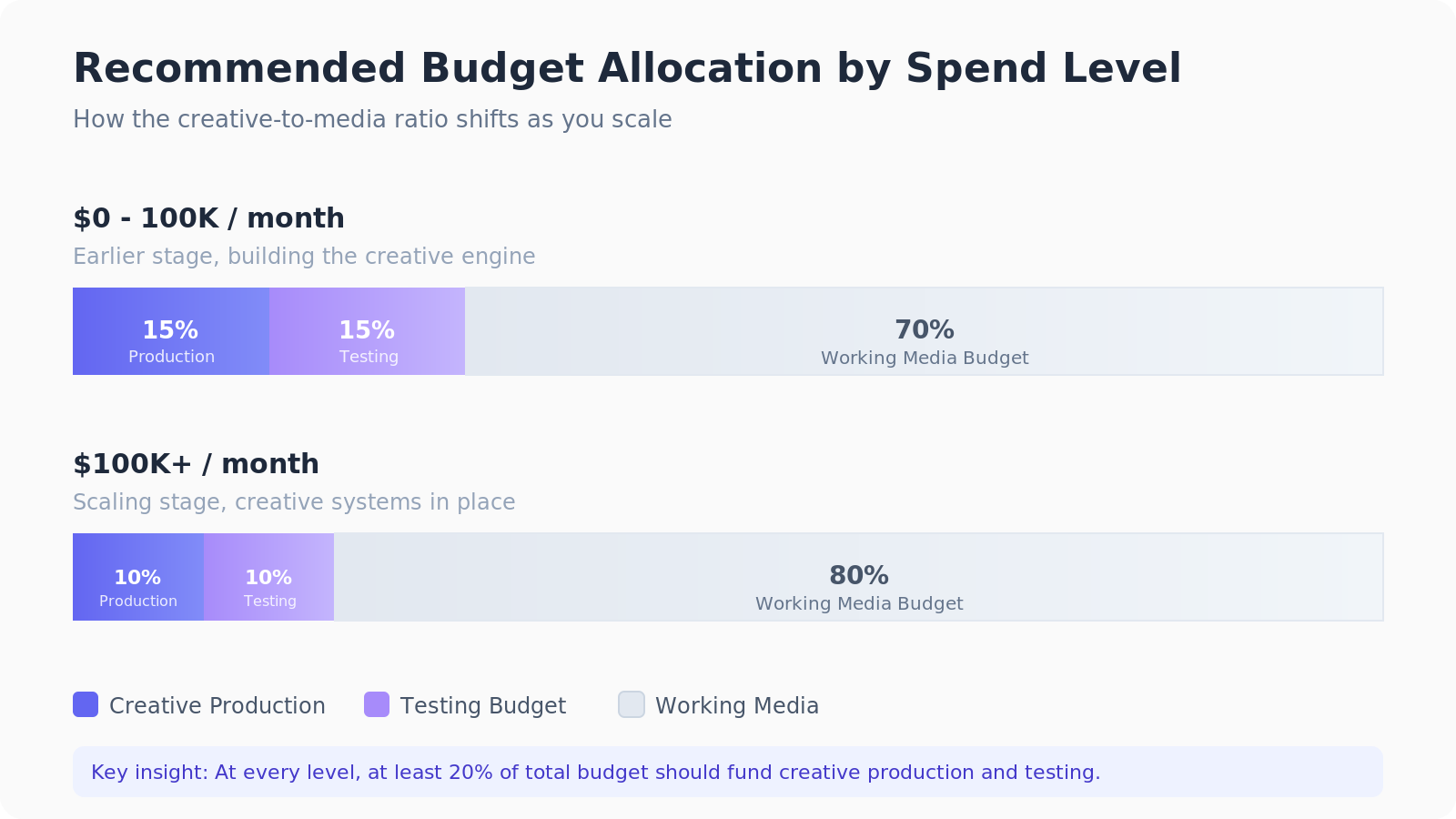
- At $0-100K/month in media spend, roughly 30% should go to creative production and testing spend, with 70% to media buying (your working budget).
- At $100K+/month, that shifts to 10% creative production, 10% testing budget, and 80% working media budget.
These ratios reflect a basic reality: the cost to produce effective creative doesn't scale linearly with media spend, but the need for fresh creative absolutely does.
A brand spending $30K/month might need 4-6 net new concepts per month to stay ahead of creative fatigue. At $150K/month, that same brand might need 15-20 net new concepts, plus another 20-30 iterations on proven winners, bringing total creative output to 40-50 assets. The production cost per asset doesn't increase 5x, but the coordination, strategy, and iteration complexity does. Creative testing budgets should represent 20%+ of total ad spend to maintain the volume of testing needed for sustainable growth.
Why Most Brands Underfund Creative (And Pay For It Later)
The most common mistake in DTC advertising is scaling media spend before you've figured out how to talk to different audience segments at different stages of awareness.
Your warm audience (people who've visited your site, engaged with content, or are in your email list) needs different messaging than cold traffic. And cold traffic that's product-aware needs completely different creative than people who don't even know the problem you solve exists.
Scaling spend before you've sorted out this messaging framework is the fastest way to tank your acquisition profitability. You're buying traffic at scale while still guessing at what converts.
The research backs this up. A MAGNA Media Study found that creative quality drives 56% of the impact on purchase intent, while research from Meta, Analytics Partners, and The Lab found that on average 70% of the potential ROI for video advertising comes from the creative itself.
Yet most brands spend 90%+ of their budget on the media side and treat creative as an afterthought.
What Properly Funded Creative Actually Looks Like
When you fund creative like infrastructure instead of treating it as a cost center, several things change.
First, you build a testing apparatus, not just ads. Instead of launching 2-3 concepts per month and hoping something works, you're running 10-15 concepts across different audience segments, measuring what works, and iterating fast. I talk about this with every new client: there is no secret formula any agency can implement for developing creative. Success comes through frequent, rapid testing, comprehensive creative strategy, and finely tuned landing pages.
Second, you develop creative for specific funnel stages. Top-of-funnel creative for cold audiences focuses on problem awareness and pattern interrupts. Mid-funnel retargeting speaks to objections and differentiation. Bottom-funnel creative drives urgency and conversion. Most brands run the same creative everywhere and wonder why their ROAS drops as they scale.
Third, you stop recycling the same concepts. Creative fatigue is real, and it's expensive. How fast it hits depends on your spend level. At $300-500K/month, even strong creative can fatigue in 2-4 weeks because the algorithm burns through audiences faster. At lower spend levels, a winning ad can run for months before performance starts to decay. But regardless of timeline, you need a pipeline of new concepts ready so you're never scrambling when a winner drops off. Meta's own research shows that click-through rates fall with repeated exposures to a given creative, and the platform will flag creative fatigue when cost per result reaches twice your previous baseline.
Two Brands That Prove the Point
FlavCity had Bobby Parrish's massive following and a product people loved, but previous agencies couldn't turn that into a scalable acquisition engine. The problem was textbook: limited creative diversity, no systematic testing framework, and paid search campaigns focused on brand conversions rather than new customer acquisition.
When FlavCity came to us, we increased creative output 10x and tested hundreds of assets across over 15 strategic angles. We rebuilt paid search from the ground up to capture consideration-stage shoppers, not just people already searching for FlavCity by name. The results: multiple ads sustaining 5x+ ROAS, with dozens of assets hitting 3x+ ROAS. Same budget. Completely different outcome because the creative engine was finally doing its job.
ZYN Turmeric tells a similar story from a different angle. The turmeric wellness drink brand came to us after disappointing DTC results with other agencies. Their product was strong, but they didn't have the creative infrastructure to support scale. We took full control of the funnel: creative strategy, paid social optimization, and conversion rate optimization, rebuilding the paid acquisition program around creative diversity and audience-specific messaging.
The results speak for themselves: CPMs decreased 73% through creative diversification and audience optimization. Meta ROAS increased 3x. Landing page conversions tripled after proper CRO implementation. Their electrolyte turmeric mix became the top-selling SKU, eventually representing over 80% of total sales. All of this happened because creative and CRO got the investment they needed before media spend scaled up, not after.
The Math That Makes This Click
Rather than run hypothetical scenarios, look at what actually happened with FlavCity and ZYN Turmeric.
In both cases, the total marketing budget didn't change dramatically. What changed was where the money went. Creative production and testing got funded as a real line item. Landing pages got rebuilt with conversion in mind. And the media buying became more efficient as a direct result, because the algorithms had better creative to work with.
FlavCity went from a handful of underperforming ads to a library of hundreds of tested assets, many running at 3-5x returns. ZYN Turmeric saw their CPMs drop by nearly three-quarters while simultaneously tripling their ROAS. These aren't incremental improvements. They're the kind of step-change that happens when creative goes from afterthought to foundation.
The principle behind both results is the same one I built this agency around: creative diversity is foundational, not optional. When creative variety is low, the algorithm learns slowly, performance plateaus, and costs rise as novelty decays. When creative variety is high and strategically diverse, the platform's prediction engine has more to work with and finds pockets of efficiency that a narrow creative set would never unlock.
The Hidden Cost of Bad Creative
Bad creative doesn't just perform poorly. It actively makes your media buying more expensive.
When your creative doesn't resonate, engagement rates drop. Low engagement signals to Meta and TikTok that your ads aren't relevant, which triggers higher CPMs. Poor creative leads to expensive media, which eats the budget that could have gone to better creative. It's a downward spiral that accelerates the more you spend.
Research from Kantar and WARC demonstrates the magnitude of this problem. Their analysis of over 450 ads found a strong correlation between high creative quality and high ROI. High-quality creative delivers an average revenue ROI of 8.1 versus just 3.3 for low-quality creative. Every month you underfund creative, you're overpaying for traffic that converts worse than it should.
How to Actually Allocate the Budget
If you're sitting down to plan your next quarter's spend, here's the framework.
Start with creative minimums, not media maximums. Figure out how many concepts you need to test per month to reach statistical significance (usually 10-15 for most DTC brands), cost that out, then allocate the rest to media. Not the other way around. This is how we work with every client: build the creative testing infrastructure first, then scale media spend into it.
Separate testing budget from scaling budget. You need money set aside specifically for creative testing, money you're willing to spend learning what works, not money you expect to be profitable from day one. Most brands try to make every dollar profitable immediately, which means they never learn what actually converts. We use a protected-budget approach for new concepts, giving untested creative a fair shot at proving itself before measuring it against established winners.
Build creative systems, not one-off productions. The brands that win aren't spending more per asset. They're building repeatable systems for production: modular shoots where you capture 20 variations in one day, templates that let you remix winning concepts quickly, and relationships with creators who understand the brand and can produce volume.
Measure creative like you measure channels. Track ROAS by concept, not just by campaign. Understand which types of creative work for which audiences. Build a library of what converts so you're not starting from zero every month.
Survey data from DTC brands shows respondents estimated allocating 37.2% of their budgets to prospecting, with 30% spent on retargeting and 32.8% on retention. Within those allocations, the brands that scale most efficiently are those investing heavily in creative variation and testing.
The Brands That Get This Right
The pattern among DTC brands that successfully scale is consistent: they treat creative as infrastructure.
They don't debate whether to "invest in creative." They budget for it the way they budget for media spend, as a fixed percentage of revenue that doesn't get negotiated away when things get tight.
They build teams, internal or agency partners, whose entire job is creative production and testing. Not brand marketing. Not "social media." Conversion-focused creative that's designed to work in paid channels.
And they measure it relentlessly. Every concept gets tracked. Every test gets analyzed. What works gets scaled. What doesn't gets killed fast.
Research on Swedish telco Tele2's creative measurement system found that converting "poor" creative to "average" increases ROI by 5x, while "good" creative drove 1.7x the ROI of "average." The compounding effect of consistently great creative is massive.
I built Y'all around this principle. Thoughtful, high-velocity creative testing. Data-backed creative strategy. Conversion rate optimization. Creative as the foundation that everything else builds on. Great media buying alone won't drive DTC growth. The real levers that impact success exist within creative strategy and ad development.
What This Means for You
At minimum, allocate 15-20% of your total paid advertising budget to creative production and testing budget. If you're at an earlier stage (under $50K/month in spend), push that to 30%.
This is money that makes your growth more efficient.
You can't media-buy your way out of a creative problem. More budget behind bad creative just means you lose money faster. FlavCity had Bobby Parrish's audience. ZYN Turmeric had an industry-pushing product. Neither could scale profitably until they invested in creative infrastructure. Once they committed to testing hundreds of concepts, developing strategic angles for different audience segments, and measuring what actually worked, the media spend became efficient.
Get the creative right, and the media spend takes care of itself. If you're stuck in that cycle of scaling spend without scaling results, let's talk about it.

.png)

