Marissa O'Halloran is the Commerce Lead of 1800DTC. When she's not researching and writing about the latest DTC products and brands, you can find her hunting down the best matcha in town, overpacking her carry-on, or hanging out with her golden retriever, Pepper.
Most brands think their ERP is the problem. Wiley Jonesthinks that's exactly the wrong diagnosis.
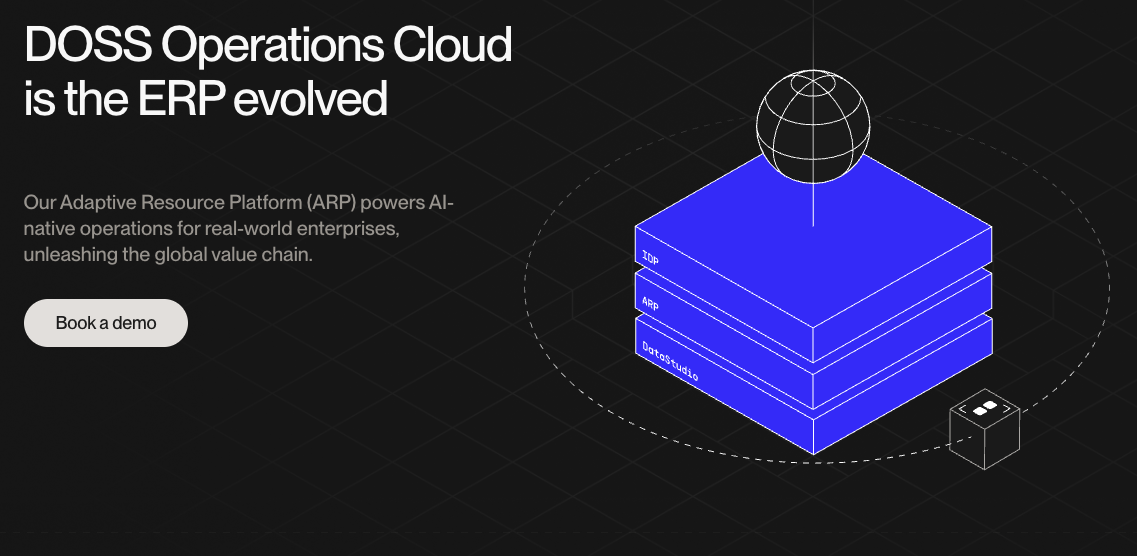
Wiley is the co-founder and CEO of DOSS, an Operations Cloud built for companies that have spent years bending their business around software that was never designed for them. DOSS sits around your existing general ledger and connects the flow of goods, dollars, and data across your value chain — without ripping anything out. No 18-month implementation. No consultant bill that rivals a down payment on a house. Just operations that actually work the way your business does.
The insight didn't come from a whiteboard. Wiley spent years bouncing between hardware startups in China, Silicon Valley, and everywhere in between, watching the same problem show up everywhere he went. Robot cat toys. Security cameras. Medical devices. Different industries, same broken system. So he called up his co-founder Arnav Mishra, and they built DOSS from scratch.
We sat down with Wiley to talk about the moment it clicked, what brands keep getting wrong about operations, and the Bezos principle that shapes how he thinks about building for the long term.
For someone hearing about DOSS for the first time, how do you describe what it does?
"We think of DOSS as the ERP evolved. As an Operations Cloud, DOSS sits around your existing general ledger and systems to connect the flow of goods, dollars, and data across your value chain without ripping anything out. And unlike legacy ERPs that assume your business will mold itself to fit the software, DOSS does the opposite: the system is built to adapt to you & your specific workflows."
What was the moment you realized this was a massive problem you needed to solve?
"I think realization came in two stages. Stage 1 was while I was working for Sprite Robotics in China, I noticed how our 7-person startup producing roughly 40K items a year had the same problems as a much larger company down the hall. iRobot's 1-million-Roombas-a-year operation was dealing with the same rigid ERP system. Scale in this case didn't matter. The constraint was the same for everyone managing physical goods. Companies had to modify their business process and physical process in order to match the greatest common denominator of software applications. That's when I knew there was a problem.
Stage 2: It wasn't until I was working at Athleas that it fully clicked. Hospitals started asking us to manage all their medical claims, not just diagnostics-related ones, because their existing systems were too inflexible. I saw the same spreadsheet-and-workaround pattern I'd lived through in hardware, now showing up in healthcare. All the problems I had seen in the past, all the going line-by-line through spreadsheets, weren't unique to hardware, it was everywhere. Fundamentally, it was a system-of-record and business process management problem. There wasn't a sufficiently agile and flexible platform for orchestrating workflows between 3rd-party and 1st-party data."
What's one thing most brands get wrong about this problem?
"They think the ERP is the problem. It's not. The problem is that somewhere along the way, someone decided that the right move was to modify your business to fit the software, instead of the other way around. And once that decision gets made, it seemingly became the standard overnight.
Back to the iRobot and Sprite Robotic example: Both of us were beholden to material planning happening on a Wednesday. Not because it made sense for us, but because that's what the ERP said. Nobody was going to crack open the system and reconfigure it for the little pet toy startup. So we just... bent our operations around the software's limitations.
That's the thing brands consistently get wrong. They look at their messy spreadsheets and their clunky workflows and they go, 'we need a better ERP.' But what they actually have is a business process problem that they've been papering over with workarounds for years, and they're about to pay a consultant $2 million to digitize those workarounds into an even more rigid black box.
The right question isn't 'which ERP should we implement?' It's 'why are we building our operations for software instead of demanding software that's built for us?'"
What's the feature customers fall in love with first?
"Definitely the speed.
They've been told their whole careers that ERP implementations take quarters or even years. That you budget years and millions of dollars in professional services just to get the thing standing up. So when we show them how fast we can actually move, there's always this moment where they just kind of stare at the screen.
But what they're falling in love with isn't the speed itself. The speed is just the proof. What they're really feeling is: this thing was built for how my business works.
We call those 'magic moments.' We don't lead with AI, we don't give them a tech stack pitch. We just sit down, understand their workflows, and show them something that makes their job dramatically simpler right in front of their eyes. One of the driving forces behind DOSS is a quote from Arthur C. Clarke: 'Technology is indistinguishable from magic. We have to defy people's expectations of these systems, show them something magical right in front of their eyes for them to believe it.'
Once you do that once, they're in."
What makes DOSS different from other solutions out there?
"We elevate the business logic to the application layer. Instead of burying it deep in ERP code, we make it fully configurable. Our workflow editor works like a flowchart. Any operator can look at it and understand exactly what's happening and why. You don't need a consultant to change it, you don't need to file a ticket, you don't need to wait six months.
The other thing is we're not trying to be the greatest common denominator. Legacy ERPs are built to serve everyone, which means they're perfectly tailored for no one. We start from real customer use cases and back them out into their essence. We build the underlying abstraction, not just the end feature. That takes more time upfront but it compounds. It's what lets us serve a coffee company, an aerospace manufacturer, and a furniture brand on the same platform without any of them feeling like they got the generic version."
What's a big shift happening in your industry that brands aren't talking about enough?
"The end of life deadlines for legacy ERPs are coming up. A generation of people who were trained on these systems are retiring, and simultaneously generative AI is rapidly improving. That's literally every possible tailwind hitting at the same time.
Typically, the conversation gets sucked into 'AI is going to automate everything' and that's just not where the bottleneck is. The bottleneck at the end of the day is still humans. It's still someone at a company who needs to understand what's happening in their operations, make a decision, and act on it.
The biggest shift is that for the first time, a small team at a startup can speed-run capabilities that legacy solutions have been building since the 1970s. You can skip steps and jump straight to the conclusion. The window to displace these incumbents has never been more open than it is right now.
Most brands are still asking 'how do we get more out of our current ERP.' The better question is: if you were starting from scratch today, would you build your operations on 40 year old infrastructure? The answer is obviously no. And more and more people are starting to realize that."
What's one lesson you learned the hard way while building DOSS?
"You cannot be everything to everyone. And the sooner you make peace with that, the better.
We started out trying to be a full ERP replacement, general ledger included. The whole thing. And what we learned is that the businesses we serve don't actually want you to rip everything out. They want their operations to work. They want inventory, orders, procurement, and fulfillment to finally make sense in one place. The GL is a different problem.
So we made a call. Doss is an Operations Cloud. We sit around your existing general ledger and connect the flow of goods, dollars, and data across your value chain. We partner with best-in-class finance tools rather than trying to own a problem that isn't ours to own.
Narrowing your focus feels like losing, but it's actually the only way to win."
If you could go back to Day 1, what would you do differently?
"Same answer as the last question. Start narrower than you think you need to.
We thought the size of the vision required the size of the surface area. It doesn't. The companies that win do one thing so well that everything else becomes inevitable. We got there, but I'd have gotten there faster."
What's the best piece of advice you've ever received?
"Bezos has this framing around long-term thinking that really stuck with me. He said the secret is identifying things that are constant in time. What is the thing that is true today that will be true tomorrow and for perpetuity. Not what's trending, not what the market is excited about right now. What is permanently true.
For us that's pretty simple. Businesses will always need to move goods. They will always need to track inventory, process orders, manage suppliers. That never changes. If you build around constants, you don't have to chase the market. The market comes to you."
[inline-cta title="Learn More about DOSS" link="https://www.doss.com/about/"]
Join 23k+ DTC Founders
Get The eCommerce Pulse
The twice-weekly briefing for operators, founders, and partners shaping modern DTC.
















.png)